


Anthropic and OpenAI Halt Secondary Market Trading of Their Shares
Anthropic and OpenAI halt secondary trading of their shares.
Anthropic and OpenAI have revised their stock policies, prohibiting secondary trading.
The statement from the former indicates that any sale or transfer of securities without board approval is invalid: the buyer will not be recognized as a shareholder and will receive no rights.
OpenAI’s announcement contains nearly identical wording: without written consent, the transfer of securities is void and holds no economic value.
Both companies identified the same list of directions: direct sales, special purpose vehicles (SPVs), tokenized equity, and forward contracts.
SPVs are companies created to hold shares of a private firm and raise capital for their purchase. Such structures have become a standard workaround for buying shares of a company that has not yet gone public.
The vulnerability of the scheme lies in the ability to create “multiple levels of SPVs”: additional companies to purchase shares of a similar structure. This complicates the verification of the legality of transactions with underlying shares.
Under the new rules of both companies, if the initial transfer of funds into an SPV is not approved by the board, the entire chain of transactions is considered invalid.
Anthropic published a list of specific blocked structures: Open Door Partners, Unicorns Exchange, Pachamama, Lionheart Ventures, Sydecar, Upmarket, Forge Global, and Hiive. The last two are the most well-known platforms for secondary trading of private company shares.
Forge Global is a regulated platform for accredited investors, where Anthropic’s estimated valuation previously reached $1 trillion, surpassing OpenAI’s $880 billion. The company reported that it was mistakenly included in the list.
“We are working with Anthropic to remove Forge’s name from this warning. Our company does not facilitate transactions with shares of any private companies without explicit approval from the firm,” the comment states.
Market Reaction
The market reacted swiftly. Following the announcements from Anthropic and OpenAI, their tokens on PreStocks—a Solana-based platform—dropped from $1400 to $873 and from $2000 to $1080, respectively.
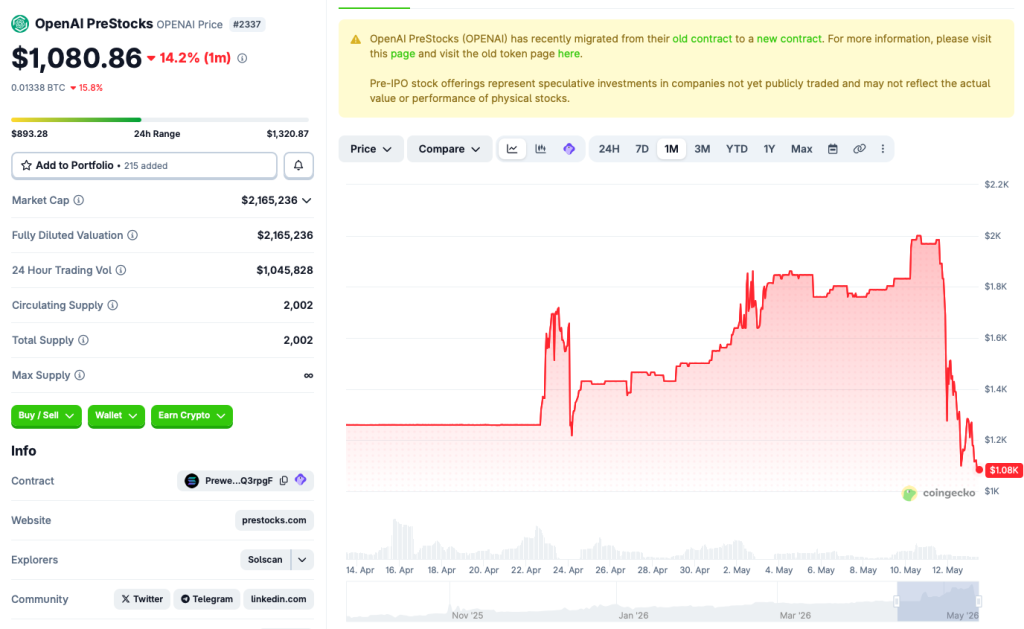
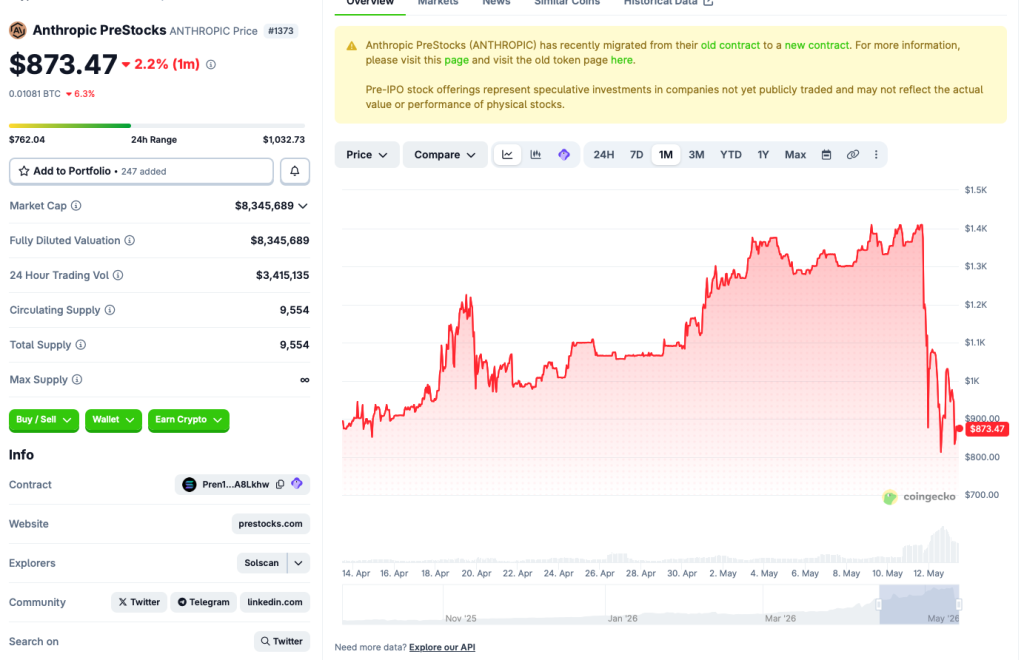
Over the past year, some crypto companies have launched investment products with access to private firm shares. These are often perpetual futures—derivative instruments that track the value of private firms on secondary markets but do not confer ownership rights to actual shares.
Reasons for the Ban
In October 2025, OpenAI conducted a board-approved tender offer: current and former employees were allowed to sell shares worth up to $30 million. More than 600 individuals collectively received $6.6 billion in a single transaction.
About 75 individuals decided to cash out the entire $30 million. The company tripled the previous limit of $10 million per employee, as the old restriction caused dissatisfaction among leading researchers and developers.
OpenAI organized the campaign and approved each transaction—this is the right private firms strive to protect. They aim to control secondary sales. The crackdown targets anyone attempting to circumvent this.
Investors, on the other hand, seek access to the rapidly growing revenues of AI startups—the very loopholes that OpenAI and Anthropic have now closed.
Back in July 2025, OpenAI denied reports of launching tokenized shares of the firm, as proposed by Robinhood.
Рассылки ForkLog: держите руку на пульсе биткоин-индустрии!