




Large holders have shifted from accumulating the first cryptocurrency to distributing it, and the trend appears long term, according to CryptoQuant analysts.
Whales have flipped from buyers to sellers.
1K–10K BTC holders are now distributing, with 1Y holdings at -188K BTC after +200K accumulation in 2024.
This isn’t short-term. The 365D trend is declining, signaling structural selling pressure. pic.twitter.com/2Y4hwwVgnI
— CryptoQuant.com (@cryptoquant_com) April 1, 2026
Over the past year, addresses holding 1,000–10,000 BTC have reduced their balances by 188,000 BTC. By contrast, in 2024 they accumulated 200,000 BTC. The 365-day trend is heading lower, indicating structural selling pressure.
“The pace accelerated sharply in the fourth quarter of 2025. Historically, persistent negative whale accumulation has coincided with periods of prolonged price weakness, and current data indicate that selling remains a significant structural headwind,” the experts noted.
Institutional buying has resumed, Strategy is accumulating, but retail investors and other market participants continue to sell. Apparent demand was negative at 63,000 BTC at the end of March. This confirms the market remains in a distribution phase, with current dynamics limiting upside for the first cryptocurrency.
Another layer of support is fading: mid-sized investors who previously added to positions are now buying more slowly.
In parallel, US demand for bitcoin is falling. The Coinbase premium index has turned negative: American investors are no longer propelling “digital gold” higher.
Possible rebound
In March bitcoin broke a five-month losing streak, adding 2.2%. This happened even as the war in Iran lifted energy prices and stoked inflation expectations, hurting other risk assets.
Even so, the cryptocurrency remains roughly 45% below the October peak of $126,000. At the time of writing the asset trades around $66,400.


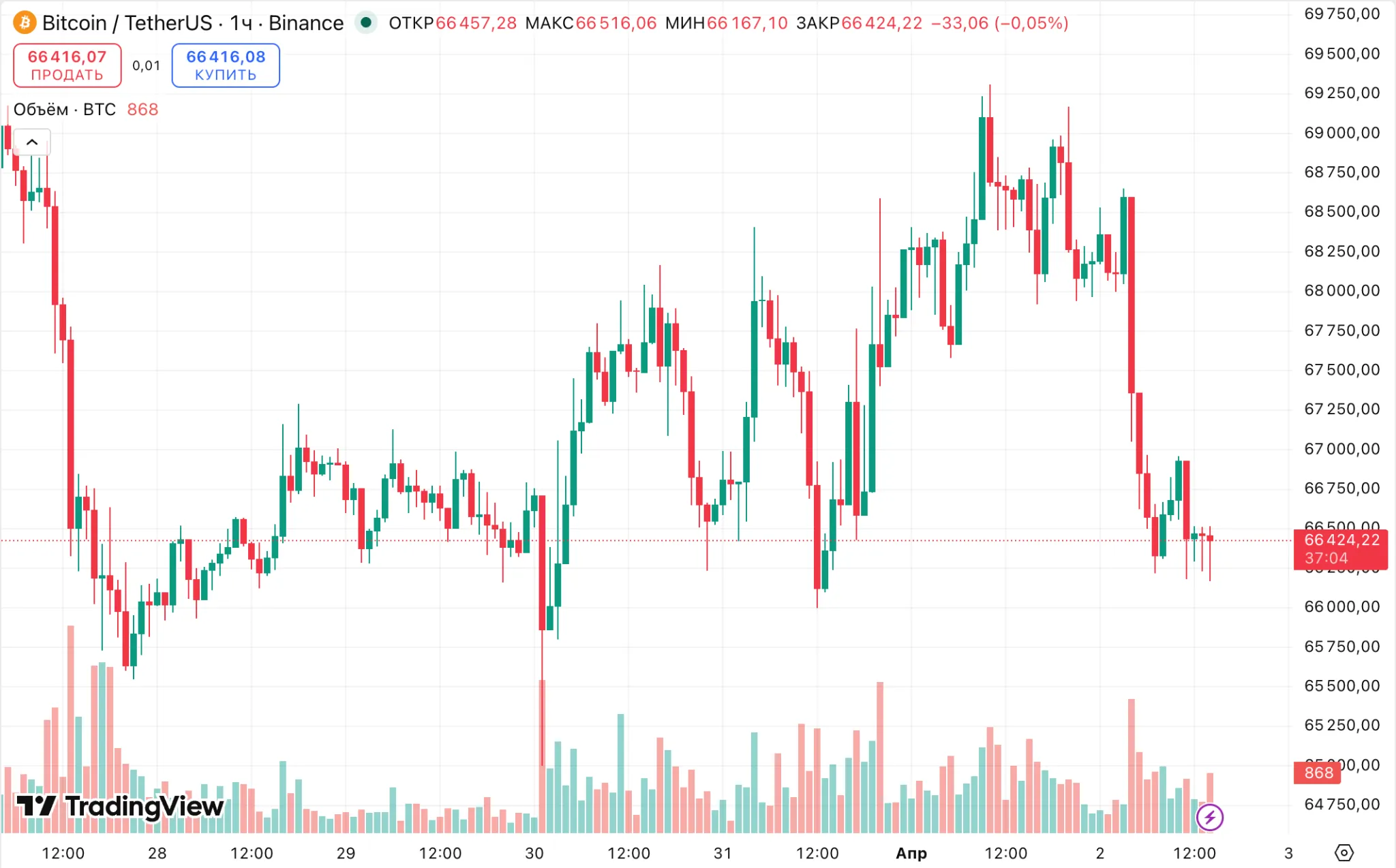
CryptoQuant sees scope for a short-term bounce. However, this would require an improvement in macro conditions, above all a de-escalation of the Middle East conflict.
“A reduction in geopolitical tensions could be a positive catalyst, potentially triggering a ‘relief’ rally,” the analysts concluded.
Extreme uncertainty
On April 1 signs emerged of a possible end to the war in Iran. US President Donald Trump said Tehran had asked the United States for a ceasefire. The prospect of an end to the conflict buoyed investors and supported prices. However, Iranian authorities immediately denied his claim.
A few hours later Trump addressed the nation, promising to “hit Iran hard.” Following those remarks, US Treasuries rallied, while the S&P 500 shed $500bn in market value within minutes. The shock spread to digital assets as well.
According to the analyst known as Darkfost, selling in Ethereum derivatives exceeded $1bn, $968m of which was on Binance alone.
🔴 $1B in ETH selling hits derivatives in 1 hour After Trump’s speech.
While markets around the world were expecting a de-escalation speech from Donald Trump regarding the conflict with Iran, his remarks went in a completely different direction.
Instead, Trump made it clear… pic.twitter.com/nz6kIK1Clw
— Darkfost (@Darkfost_Coc) April 2, 2026
That pushed the leading altcoin down nearly 5% over the past 24 hours. At the time of writing it trades around $2,000.

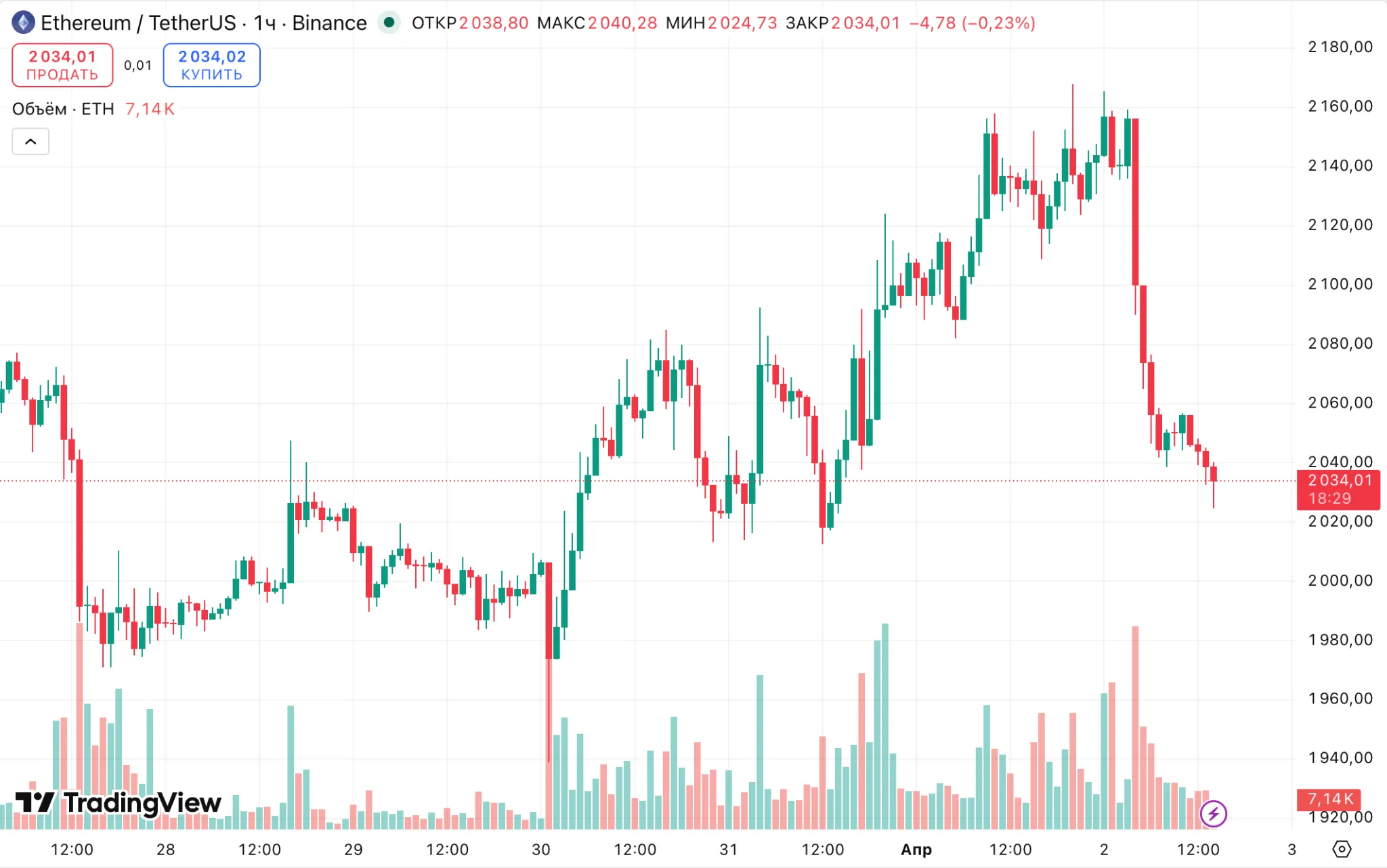
“Overall, financial markets are now facing a period of extreme uncertainty and volatility, making price action increasingly fragile and unpredictable,” Darkfost noted.
Positive signal
Activity on crypto exchanges has returned to levels that in past cycles marked structural market resets. The Fund Flow Ratio has compressed to ~0.065, said CryptoQuant researcher Ignacio Moreno de Vicente.
Exchange Activity Is Back at Reset Levels — Or Losing Relevance?
“If it breaks materially below prior support, then this time the contraction would look less like a healthy reset and more like a deeper deterioration in market engagement.” – By @MorenoDV_ pic.twitter.com/lsOijUgqVB
— CryptoQuant.com (@cryptoquant_com) April 2, 2026
Historically, this zone has repeatedly acted as a “market reset level” during broader bull cycles: in 2017, 2018, 2019, 2020 and 2023.
On each prior occasion when the 30-day Fund Flow Ratio fell to similar levels, bitcoin either completed a correction or moved through a consolidation that was followed by gains.
Earlier, Glassnode analysts noted stagnation in the leading cryptocurrency. In their view, the market needs a catalyst to shift the trend.