



Top ten bitcoin miners: strategies and trends
How the biggest bitcoin miners are reshaping after the halving and pivoting to AI.
In 2026 the bitcoin-mining industry is undergoing a sweeping transformation. The effect of halving and shrinking margins has forced miners of the original cryptocurrency to overhaul their business models. Some are pursuing aggressive acquisitions; others are diversifying by leasing capacity for AI workloads.
ForkLog examined the distinctive strategies of the leading mining firms.
The material uses data on the operational hashrate (EH/s) of mining companies actually deployed in production, sourced from the aggregator BitcoinMiningStock as of March 25, 2026.
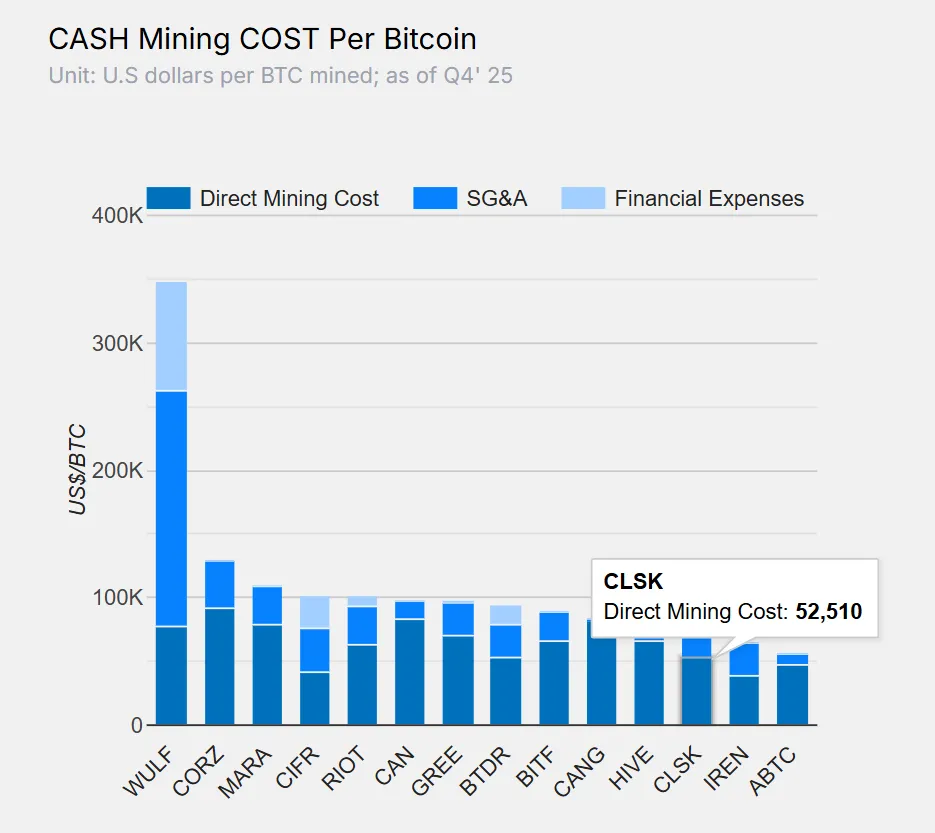
The estimated cost to mine 1 BTC includes electricity and other company expenses. Figures are drawn from Q4 2025 financial reports published by TheEnergyMag.
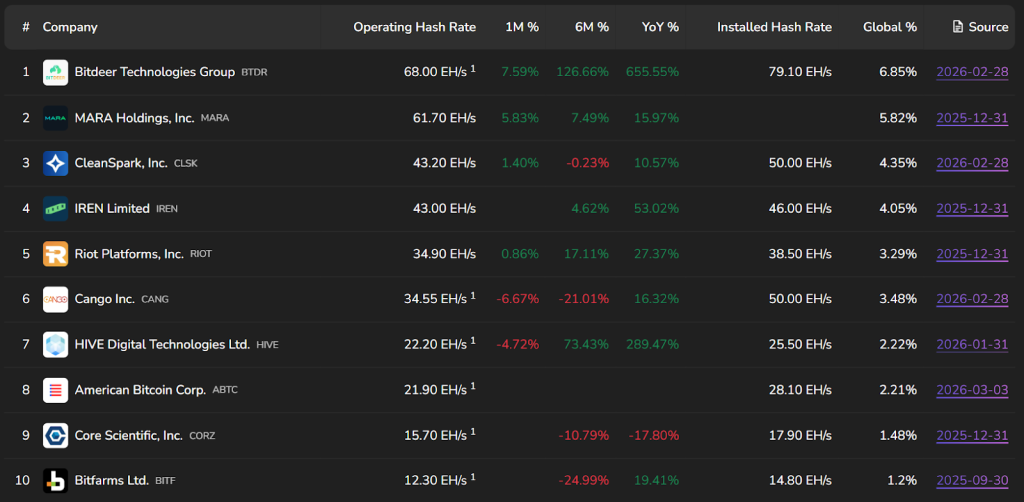
1. Bitdeer Technologies (BTDR)
Founded: 2020
Operational hashrate: 68 EH/s
Cost to mine 1 BTC: $93,986
Founded by Jihan Wu, Bitdeer is, for now, the chief beneficiary of 2026. Its operational hashrate rose 655% year on year. Unlike most rivals, the company uses ASIC chips of its own design.
Bitdeer’s data centres span the globe, from Texas and Ohio to Norway and Bhutan. In-house ASIC devices and access to cheap green power keep direct mining costs low—$52,660.
At the start of 2026 the miner accelerated its shift to AI infrastructure—launching GPU clusters from Nvidia in Malaysia and planning to repurpose sites in the US and Europe. In February, to cover expenses, Bitdeer sold all mined and held coins—about 943.1 BTC (~$66m at the time of writing).
2. MARA Holdings (MARA)
Founded: 2010 (pivot to mining in 2017)
Operational hashrate: 61.7 EH/s
Cost to mine 1 BTC: $108,271
In 2017 the company radically shifted from intellectual-property enforcement in technology to cryptocurrency mining.
MARA is the second-largest holder of bitcoin among public companies. Beyond mining, it periodically adds to its reserves. As of March 25, 2026 it had under management 52,850 BTC worth $3.77bn.
In addition to sites in Texas, North Dakota and Nebraska, the company’s footprint has expanded to facilities in the UAE, Finland and Paraguay at the Itaipu hydropower plant. The fleet is built around Bitmain Antminer S21 and S21 Pro.
In February 2026 MARA unveiled a multi-year transformation strategy—“from a pure bitcoin miner to an energy and digital infrastructure company”.
The firm obtained the right to invest up to 50% in each project, while retaining the option to continue mining at sites with favourable power tariffs.
3. CleanSpark (CLSK)
Founded: 1987 (pivot to mining in 2020)
Operational hashrate: 43.2 EH/s
Cost to mine 1 BTC: $73,499
CleanSpark began as a developer of software for local grid management—an engineering background that became its trump card in mining. The company’s direct cost to mine 1 BTC was $52,510.
CleanSpark earned its giant status during the crypto winter of 2022. While competitors choked on debt, the company, with a strong balance sheet, began methodically buying discounted sites and the latest ASIC miners. A strategy of aggressive acquisitions of rivals and expertise in power distribution secured it a place in the top three.
CleanSpark is firmly rooted in the United States—its core infrastructure is concentrated in Georgia, Mississippi and Wyoming. The company is one of the world’s largest buyers of Bitmain Antminer S21, achieving a fleet efficiency of 16.07 J/TH.
CleanSpark uses substantial bitcoin reserves (13,099 BTC) as working capital, obtaining credit lines secured by cryptocurrency. In parallel, the firm is adapting its infrastructure for AI, expanding its team and seeking tenants for compute.
4. IREN (IREN)
Founded: 2018
Operational hashrate: 43 EH/s
Cost to mine 1 BTC: $64,222
The Australian project IREN, founded by the Roberts brothers, made an uncompromising bet on renewable energy from the outset. In 2022, however, as profitability fell, the company had to hand over part of its ASIC miners to a lender. It preserved the essentials—data centres and power infrastructure.
Having weathered the crisis, IREN staged one of the industry’s most successful comebacks. It was among the first to buy Nvidia flagship GPUs at scale for cloud AI workloads. A hybrid model of mining and data centres, together with a complete abandonment of cryptocurrency reserves, made IREN attractive to investors, as reflected in a record $13.6bn market capitalisation.
IREN’s facilities are located in Canada’s British Columbia and Childress, Texas. Reliance on hydro and wind power lowered direct costs to mine 1 BTC to $38,000, making the company a leader in energy efficiency.
5. Riot Platforms (RIOT)
Founded: 2000 (pivot to mining in 2017)
Operational hashrate: 34.9 EH/s
Cost to mine 1 BTC: $101,316
Originally called Bioptix, the firm made diagnostic equipment for veterinary medicine. Today all Riot’s capacity is concentrated at its Rockdale, Texas site (700 MW, immersion cooling). Mega-sites are under construction in Corsicana (1,000 MW, immersion cooling) and Kentucky (60 MW, air cooling).
Unlike most rivals dependent on Bitmain, Riot has a strategic partnership with manufacturer MicroBT. It has bought WhatsMiner M66S and M56S+ models designed specifically for liquid cooling.
Thanks to contracts with Texas grid operator ERCOT, the company receives colossal “power credits” for voluntarily shutting down equipment during peak state-wide loads.
In January 2026 the company purchased for $96m a plot of roughly 81 hectares next to its flagship Rockdale data centre. It financed the deal with its own funds by selling 1,080 BTC. Under an agreement with AMD, Riot will provide the partner with a phased rollout of AI compute in January–May 2026.
6. Cango (CANG)
Founded: 2010 (pivot to mining in 2024)
Operational hashrate: 34.55 EH/s
Cost to mine 1 BTC: $82,026
Historically, Cango is a Chinese financial platform for the auto industry. But in late 2024, hundreds of millions of dollars of surplus capital were directed to acquiring ASIC miners and crypto infrastructure. The manoeuvre allowed the company, in barely a year, to burst into the top tier of global bitcoin mining, overtaking many market veterans.
Cango’s fleet consists of Bitmain Antminer S19 XP ASIC miners installed at manufacturer-operated sites. This model let the firm scale hashrate quickly without spending the capital and time to build data centres, but it left the company exposed to hosting tariffs.
In February 2026 Cango sold 4,451 BTC to reduce debt and strengthen its balance sheet. In March the firm unplugged 30% of its hashrate. Instead of hoarding and mining, it now treats bitcoin as a treasury asset to finance new AI initiatives.
7. HIVE Digital Technologies (HIVE)
Founded: 2017
Operational hashrate: 22.2 EH/s
Cost to mine 1 BTC: $74,338
For years the company stood out by mining Ethereum on GPUs in parallel with bitcoin, until the network moved to Proof-of-Stake. HIVE then retrofitted its GPU farms for high-performance AI computing.
HIVE’s data centres are in regions rich in green energy: Canada, Sweden and Iceland. Cheap hydro and geothermal power in a cold climate lowers cooling costs.
In March 2026 HIVE Digital Technologies launched its first AI GPU cluster in Paraguay. Earlier the miner announced it would wind down bitcoin mining in Sweden and expand GPU capacity in Canada.
8. American Bitcoin (ABTC)
Founded: 2025 (2017—registration of parent Hut 8)
Operational hashrate: 21.9 EH/s
Cost to mine 1 BTC: $56,279
The company emerged from a merger with parent Hut 8. Before that, in exchange for virtually its entire fleet of devices, it obtained 80% of American Data Centers, a vehicle backed by investors led by Eric Trump and Donald Trump Jr. The enterprise was relaunched as American Bitcoin.
In March 2026 the miner bought an additional 11,298 ASIC devices for its Drumheller (Canada) data centre, with a stated energy efficiency of 13.5 J/TH. The upgrade will add 3.05 EH/s of compute. The fleet will reach 89,242 units.
The company ranks among the top three for direct costs to produce 1 BTC, at $46,916.
9. Core Scientific (CORZ)
Founded: 2017
Operational hashrate: 15.7 EH/s
Cost to mine 1 BTC: $129,945
At the end of 2022, while the world’s largest miner, the company succumbed to debt amid the market crash and troubles at major client Celsius Network and filed for bankruptcy. In early 2024 a court approved reorganisation with a relisting under the ticker CORZ.
The return was marked by a deal: in 2024 Core Scientific signed a $3.5bn contract with the AI-hyperscaler CoreWeave to convert part of its data centres for high-performance computing, becoming a locomotive for the convergence of crypto mining and AI.
In July 2025 CoreWeave signed an agreement to acquire Core Scientific, valuing it at $9bn.
In March 2026 the miner announced the sale of all 2,537 BTC it owned and the receipt of a $500m loan to build AI data centres. The company plans to fund equipment purchases, preliminary construction work, land acquisitions and new power connections for data centres.
10. Bitfarms (BITF)
Founded: 2017
Operational hashrate: 12.3 EH/s
Cost to mine 1 BTC: $89,494
Canada’s Bitfarms built its business on geographic diversification. While many fought for sockets in Texas, it rolled out farms in Canada, Argentina and Paraguay, where ultra-cheap hydro power is abundant but far from big cities.
In 2024 Bitfarms weathered an aggressive hostile-takeover attempt by Riot Platforms. To thwart it, the miner used a classic Wall Street defence—the “poison pill”.
After the incident the company carried out a fleet upgrade. Bitfarms placed its main bet on South America, installing 10,000 Antminer T21 units designed to operate in extreme temperatures.
At the end of 2025 Bitfarms announced a gradual wind-down of bitcoin mining and a pivot to AI infrastructure by 2027. The first step will be converting an 18 MW farm in Washington state.
Рассылки ForkLog: держите руку на пульсе биткоин-индустрии!