



The market for tokenised US Treasuries on Ethereum has hit a new all-time high. The segment’s market capitalisation reached $8bn, according to Token Terminal.
The market cap of tokenized U.S. Treasuries on @ethereum is at an ATH of ~$8 billion, up ~100% over the past six months.
Key drivers of growth: BUIDL (Securitize), JTRSY (Centrifuge), iBENJI (Franklin Templeton), WTGXX (WisdomTree), USDY (Ondo Finance), and USTB (Superstate). pic.twitter.com/WNE56wSyhE
— Token Terminal 📊 (@tokenterminal) May 5, 2026
The tally has doubled over the past six months. Key drivers include:
- BUIDL (Securitize);
- JTRSY (Centrifuge);
- BENJI (Franklin Templeton);
- WTGXX (WisdomTree);
- USDY (Ondo Finance);
- USTB (Superstate).
Treasuries remain among the most sought-after asset classes in the segment. US government bonds are widely regarded as the world’s most stable and liquid investment instrument.
Tokenisation via XRP Ledger
JPMorgan and Mastercard carried out the first cross-border redemption of a tokenised Treasuries fund via the Ripple blockchain.
As part of the pilot, Ondo Finance settled an OUSG transaction on the XRP Ledger. Mastercard’s Multi-Token Network sent instructions to JPMorgan Kinexys, and dollars were credited to Ripple’s account in Singapore.
Ondo called it the first instance of a public blockchain and global banking infrastructure settling a tokenised fund together in real time.
Thrilled to work with the teams at JP Morgan, Ripple, and Mastercard on this.
This is how crypto and tradfi rails come together: the first time tokenized tbills are settled cross border and banks, near real time.
Go in real time from tokenized tbills in bank in country 1 —>… https://t.co/hyuzJ4E9Me
— Ben Grossman (@ben_grossman) May 6, 2026
The pilot extends experiments that JPMorgan and Ondo began in May 2025, when they tested moving tokenised bonds across public networks.
Still early days
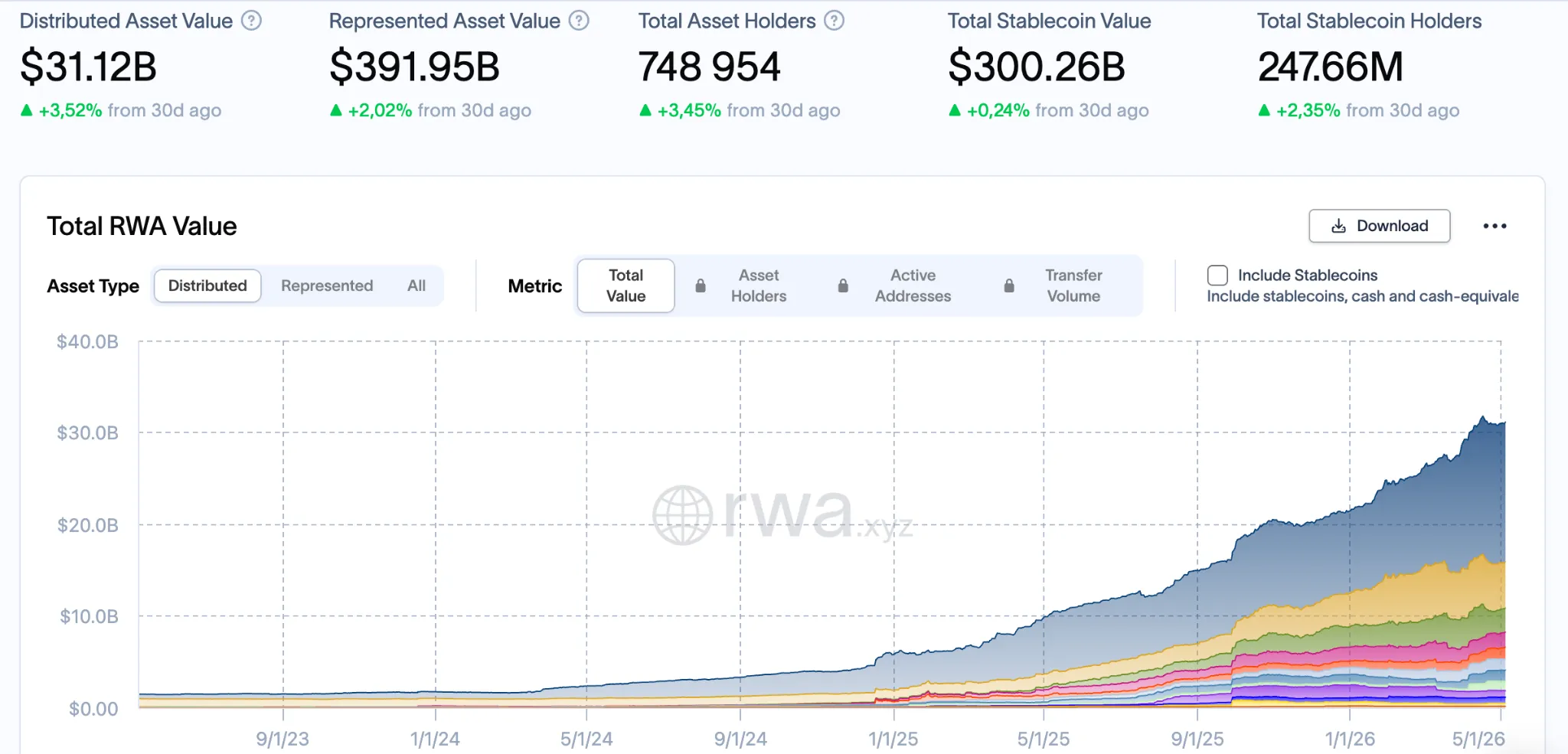
According to analysts at Pantera Capital, the market for tokenised assets remains a long way from a fully fledged on-chain financial system. Even so, the segment’s capitalisation has reached $31.1bn.


The fund assessed 524 digitised assets across 11 categories using its Tokenization Progress Index (TPI), which rates project maturity on a 1–5 scale. The market average was just 2.04.
Pantera estimates:
- around 77.6% of assets are still wrappers atop traditional infrastructure;
- 11.1% use a hybrid model;
- only 2.7% can be deemed truly native on-chain instruments.
Analysts likened the industry’s state to the early internet — “a newspaper on a website” — when new technologies replicate old models rather than create new formats.
Pantera argues that most issuers still port traditional financial products to blockchains without tapping core advantages: programmability, composability, instant settlement and automated asset management.
The sticking points
Experts highlighted the main challenges facing the RWA segment:
- dependence on custodians and centralised intermediaries;
- limited issuance and redemption mechanisms;
- weak integration with DeFi;
- low process automation.
According to the report, 91.1% of assets still use closed issuance and redemption models. Only 13 projects have achieved near-fully autonomous mint-and-burn mechanics.
Only 10.6% of assets have meaningful DeFi composability. The exception remains stablecoins. Pantera called “stable coins” the only segment that has already achieved large-scale real utility in the on-chain economy.
Growth nonetheless
Growth continues to accelerate. In 2025, 168 new tokenised assets launched — up from 78 a year earlier. The total market size jumped from roughly $200bn to $320bn.

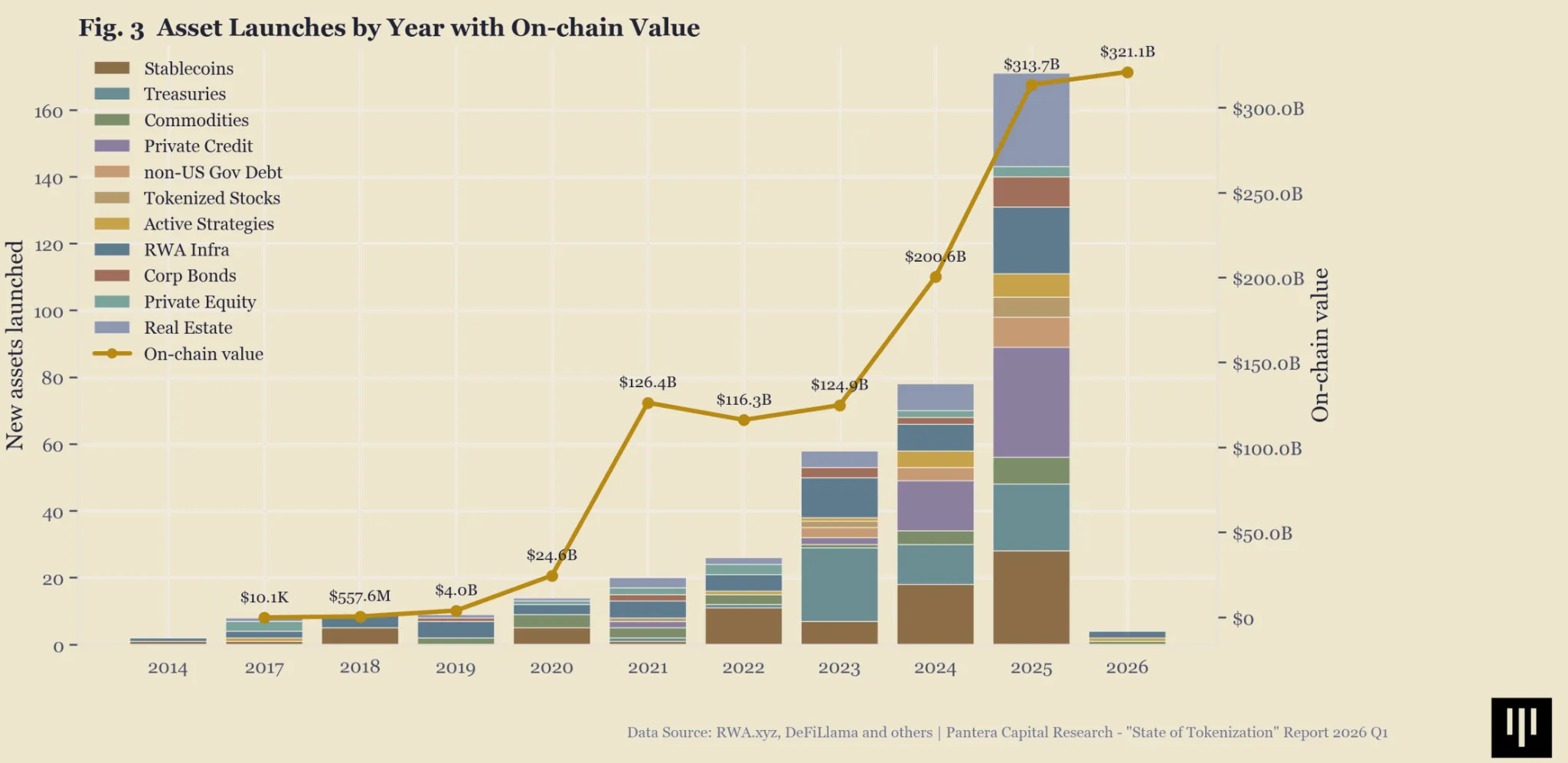
Stablecoins remain the key segment. Tokenised US Treasuries are also growing quickly alongside them.
But Pantera stressed that true maturity will come only when such assets stop being digital facsimiles and fully exploit the advantages of blockchain.
Kraken’s view
A similar assessment came from Kraken co-CEO Arjun Sethi in a conversation with The Block. He said tokenised equities are unlikely to change how large US financial institutions operate overnight.
He noted that the exchange’s xStocks product has processed roughly $5bn in transactions since its launch in June 2025. Sethi called RWA the next stage of crypto-market development after bitcoin, altcoins and stablecoins.
But he warned that even clearer regulation in the United States will not trigger instant mass adoption by banks, brokers and other players.
“I don’t think this will open the floodgates the way many expect. Brokers, banks and institutions will not change their collateral systems in a day,” he said.
Sethi added that demand for tokenised equities is currently strongest among fintech companies outside the US — in Mexico, Brazil, and countries in Africa and South-East Asia.
Broad adoption of such instruments is five to ten years away, he reckons.
In May, Ethereum co-founder Joseph Lubin predicted a full shift of the global economy on-chain.