


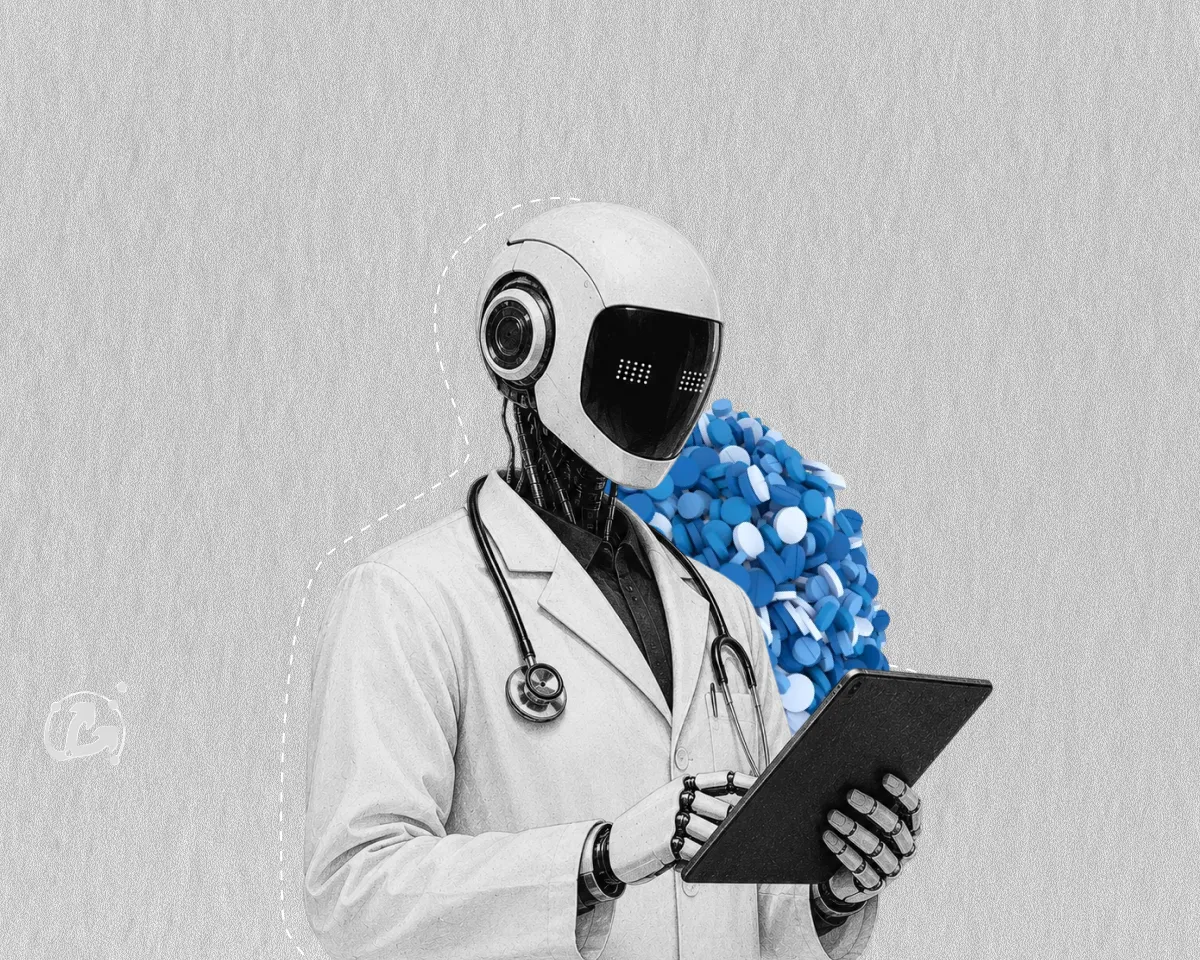
The sensible person’s AI
How artificial intelligence is changing medicine
Hype, speculation and alarming forecasts aside, few specialists doubt that artificial intelligence will change the world. Who gains and at what cost remains unsettled.
History shows that breakthroughs bring crises as well as opportunities, forcing societies to rebalance. One field, though, has long shown almost unambiguous gains from technological progress: medicine.
ForkLog examines how, even today, AI accelerates the creation of new drugs, optimises lab workflows, sharpens diagnosis and reshapes approaches to treatment.
Drug discovery
Most medicines act by binding to protein receptors—molecular structures that regulate cellular function and feature in almost all bodily processes.
AI systems can analyse receptor structures and predict which compounds will bind most effectively with minimal side-effects. That is why tasks that once took years of lab work are increasingly being solved in months.
According to estimates by the World Health Organization (WHO), most new pharmaceuticals in the coming years will in some way be developed with AI.
AlphaFold and Isomorphic Labs
In 2024 the Nobel Prize in Chemistry went to David Baker, Demis Hassabis and John Jumper. The latter two work at Google DeepMind and were recognised for protein-structure prediction methods, including AlphaFold, built on machine learning.
In 2018 AlphaFold took first place in the protein-structure “contest” Critical Assessment of Structure Prediction (CASP), excelling in the hardest categories. Two years later, at the next CASP, a new version—AlphaFold 2—won.
In 2021 Google DeepMind released the AlphaFold2 code and a database of predicted protein structures. Around the same time Hassabis founded Isomorphic Labs, an Alphabet subsidiary focused on AI for drug discovery.
In 2024 Isomorphic Labs struck partnerships with Eli Lilly and Novartis. The deals envisaged funding of up to $1.7bn and $1.2bn, respectively, for the company’s AI research. In 2026 Isomorphic Labs also announced a partnership with Johnson & Johnson.
In February 2026 Isomorphic Labs unveiled a universal drug-design environment, Drug Design Engine (IsoDDE), built on AlphaFold technologies.
The firm is working on oncology and immunology. Despite AI-driven acceleration, projects remain at the preclinical stage. The company expects to begin first-in-human trials in the coming years.
Exscientia and Recursion Pharmaceuticals
Founded in 2012, Exscientia was among the first companies to apply machine learning systematically to drug design.
In 2020 the drug DSP-1181 for therapy in OCD became the first AI-designed product to reach clinical trials. The project was conducted with Japan’s Sumitomo Dainippon Pharma, which handled synthesis and lab tests, guided by Exscientia’s theoretical results.
By 2023 the company had eight candidate molecules ready, developed “substantially faster” than the industry average.
In 2024 Recursion Pharmaceuticals acquired Exscientia in a $688m deal. Some research programmes were shut.
By then several drugs had reached phase II—testing efficacy and side-effects in a cohort of 100–300 patients.
The tie-up with Recursion Pharmaceuticals combined Exscientia’s AI systems with an automated lab-testing complex. Recursion also built its own AI supercomputer, BioHive-2, on NVIDIA H100s to train specialised models.
The company also contributed to the open, generative model Boltz-2 for predicting proteins’ three-dimensional structures.
By 2025 Recursion Pharmaceuticals focused on four oncology programmes and two related to rare diseases. Several drugs sit between phase I and II:
- REC-4881 for familial adenomatous polyposis, a disease that increases the risk of colorectal cancer;
- REC-617 for ovarian malignancies;
- REC-1245 for lymphoma and other cancers.
REC-3565, designed for treating chronic lymphocytic leukaemia, is in phase I trials.
Insilico Medicine
Founded in 2014, Insilico Medicine is another significant player in AI-driven drug development.
In 2017 Insilico Medicine was named to Nvidia’s top five for social impact.
The company uses AI across the development cycle:
- PandaOmics identifies biological “targets”—molecules to be “switched off” or modulated by therapy;
- Chemistry42 provides generative design of candidate compounds;
- InClinico optimises clinical-trial forecasting.
One early AI milestone for Insilico Medicine is Rentosertib (ISM001-055), linked to fibrosis treatment. Development took 18 months from an AI-identified target to a candidate molecule. As of 2025, Rentosertib is in phase II trials.
Also in 2024, the AI-designed immunomodulatory ISM3312 for COVID-19 and other viral infections completed phase I. ISM3091, related to cancer therapy, was admitted to patient testing.
Diagnostics and research
Specialists estimate that about 90% of all medical information is represented by images such as X-rays and scans. These data are critical to diagnosis, but labour-intensive and tricky to read.
Machine-learning methods, especially convolutional neural networks, suit complex visual pattern recognition. Much like human vision, such systems can pick out contrasts, edges, shapes and textures. This allows tumours, bleeds and other anomalies to be found with high confidence.
Model training benefits from high-quality datasets—large archives of documented images with expert annotations.
In 2024 researchers at Harvard Medical School presented an AI model, Chief, that can detect several cancers. According to the team, it correctly spotted signs of disease on digital images in 94% of cases.
In 2025 America’s Food and Drug Administration (FDA) granted “breakthrough device” status to Damo Panda, a model from Alibaba’s Damo Academy.
According to its developers, the system can flag pancreatic cancer on scans before symptoms appear—vital for this particularly insidious disease.
In 2026 a significant breakthrough in AI diagnostics was REDMOD, developed by the Mayo Clinic, a US non-profit.
The model, also aimed at detecting pancreatic cancer, outperformed specialists at early-stage diagnosis. The researchers said it found pathological changes on scans a median 475 days before diagnosis.
Google’s initiatives
Google is a key provider of AI for medical diagnostics and research.
The company offers MedGemma, an open family of models for medical text, image and audio analysis MedGemma based on Gemma 3.
Through Health AI Developer Foundations, developers can access open weights and tools.
Google collaborates with clinics and research organisations, focusing on foundational technologies.
In 2019 the company introduced a model to detect and forecast lung cancer. It matched or beat a panel of six certified radiologists.
In 2020, with Northwestern Medicine, researchers demonstrated a system for mammogram analysis that could detect cancer at a specialist’s level.
In 2024 Google Cloud and Germany’s Bayer announced a platform for X-ray screening. It reviews imaging histories and medical records to suggest possible pathologies.
NVIDIA and GE HealthCare’s autonomous imaging
Tech giant Nvidia and American medtech firm GE HealthCare, a maker of X-ray equipment, are developing an AI system for autonomous image acquisition.
Unlike models that analyse images after the fact, this system aims to reduce clinicians’ routine workload and standardise diagnostics.
The first phase will focus on X-rays and ultrasound.
GE HealthCare also plans to use NVIDIA Isaac for Healthcare, a platform for building autonomous medical systems, including surgical robots.
PathAI’s diagnostic platform
Founded in 2016, PathAI has built a “digital pathology platform”, AISight Dx, for primary diagnosis in clinical settings.
The system provides a workspace for medical images with the option to plug in third-party algorithms.
The platform supports a set of CE‑IVD-certified, AI-based tools—specifically, oncology “plug-ins”:
- DeepDx Prostate automatically highlights tissues and flags potentially important regions;
- Histotype Px Colorectal predicts disease course from images, gauges the value of chemotherapy and offers therapeutic suggestions;
- Visiopharm detects and counts biomarkers for various cancers.
The platform also includes native functions for automated image analysis, diagnostic assistance and report drafting, but these are “for research use only” and not permitted for clinical application.
AISight Dx also offers built-in assistive AI tools:
- ArtifactDetect, to find scanning artefacts and other image errors;
- Case Priority, to prioritise clinical cases based on tissue analysis;
- AIM-Tumor Cellularity, to assess tumour cellularity.
In 2022 the platform received US FDA clearance via 510(k) and Europe’s CE mark, attesting to safety for consumers and the environment.
In 2025 PathAI announced a partnership with the Moffitt Cancer Center in Florida, USA, to deploy AISight Dx in diagnostics. In 2026 the company signed a similar agreement with University Hospital Zurich.
In May 2026 Swiss drugmaker Roche said it would acquire PathAI in a deal worth over $750m.
Pitfalls and limits
As elsewhere, AI in medicine exposes old problems and creates new ones.
AI assistants, especially those based on LLMs, are prone to hallucinations.
In a research paper on Med-Gemini by Google, an error surfaced: the model “invented” a non-existent brain region called the basilar ganglia.
The hallucination blended two real anatomical terms: the basal ganglia and the basilar artery. The developers blamed a typo, but several specialists called the incident a worrying example of the risks of deploying AI assistants in medicine.
Researchers at Stanford University found that some models could convincingly diagnose from medical images without access to the images themselves.
One system scored highly “blind” on a radiology test. GPT-5, Gemini 3 Pro and Claude Opus 4.5 “confidently described visual details” on non-existent images.
According to a June study, in a medical context 7.1% of GPT-4’s replies to patient questions were incorrect and could have caused significant harm. One in 156 posed a life-threatening risk.
As of 2025, tools that auto-generate documentation from doctor–patient conversations introduced errors into 70% of clinical notes—adding false facts, omitting points and muddling concepts.
Beyond inventing organs, LLMs are notoriously opaque, making it hard for humans to interrogate their reasoning.
Poorly representative datasets can bake in biases and spurious correlations.
Meanwhile, familiar issues for AI assistants—user over-reliance and data privacy—are only sharper in healthcare.
WHO experts class medical AI as high risk.
Under Europe’s AI Act, from August 2026 such systems must meet special requirements for risk management, reporting and human oversight.
Despite the challenges and risks, WHO sees promise in medical AI—given proper rules and government oversight.
The US FDA is also optimistic about AI’s prospects, while acknowledging that current regulation is dated. In the US these systems are formally classed as Software as a Medical Device.
In 2025 the FDA published guidance on product lifecycle, risk management and marketing.
Рассылки ForkLog: держите руку на пульсе биткоин-индустрии!