


OpenAI Introduces GPT-5.5 Instant to ChatGPT
OpenAI launches GPT-5.5 Instant, replacing GPT-5.3 as default.
OpenAI has launched the GPT-5.5 Instant model and begun its integration into ChatGPT. This new version will replace GPT-5.3 Instant as the default neural network and will be available to all users within two days.
GPT-5.5 Instant is starting to roll out in ChatGPT.
It’s a big upgrade, giving you smarter, clearer, and more personalized answers in a warmer, more natural tone.
And it’s also more concise, which we heard you wanted. We think you’ll love chatting with it. pic.twitter.com/HSQOhjqxp7
— OpenAI (@OpenAI) May 5, 2026
“This is a significant upgrade, providing smarter, clearer, and more personalized responses in a friendly and natural tone,” the announcement stated.
GPT-5.5 Instant’s responses have become more concise and accurate, particularly in medicine, law, and finance. The model performs better in everyday tasks: image analysis, natural sciences, mathematics, and engineering queries.
In internal evaluations, GPT-5.5 Instant produced 52.5% fewer incorrect answers compared to GPT-5.3 Instant. The number of inaccurate statements in particularly complex dialogues was reduced by 37.3%.
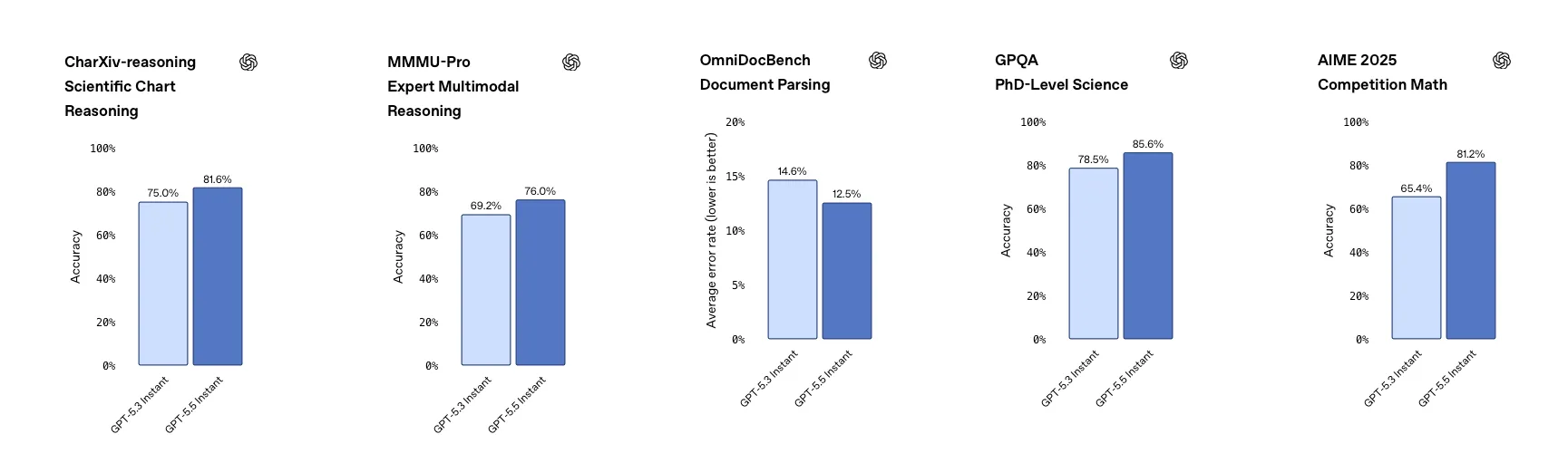
“GPT-5.5 Instant is generally a smarter model, better at handling everyday tasks,” the announcement stated.
LLM independently determines when it makes sense to consult the internet.
Memory and personalization features have been improved: ChatGPT now more effectively considers context from saved data, past chats, files, and connected Gmail accounts. Users can see which data was used and can update, delete, or disable it.
Personalization updates are gradually appearing for Plus and Pro plan holders in the web version; mobile app support will follow later.
OpenAI’s Comeback
OpenAI has significantly strengthened its position in programming—a field where the company traditionally lagged behind competitors. The number of downloads of its Codex solution rose from 5 million to 86 million in five days, surpassing downloads of Claude Code.
Downloads of Anthropic’s tool from April 27 to May 3 decreased from 11.8 million to 7.2 million, according to TickerTrends data.
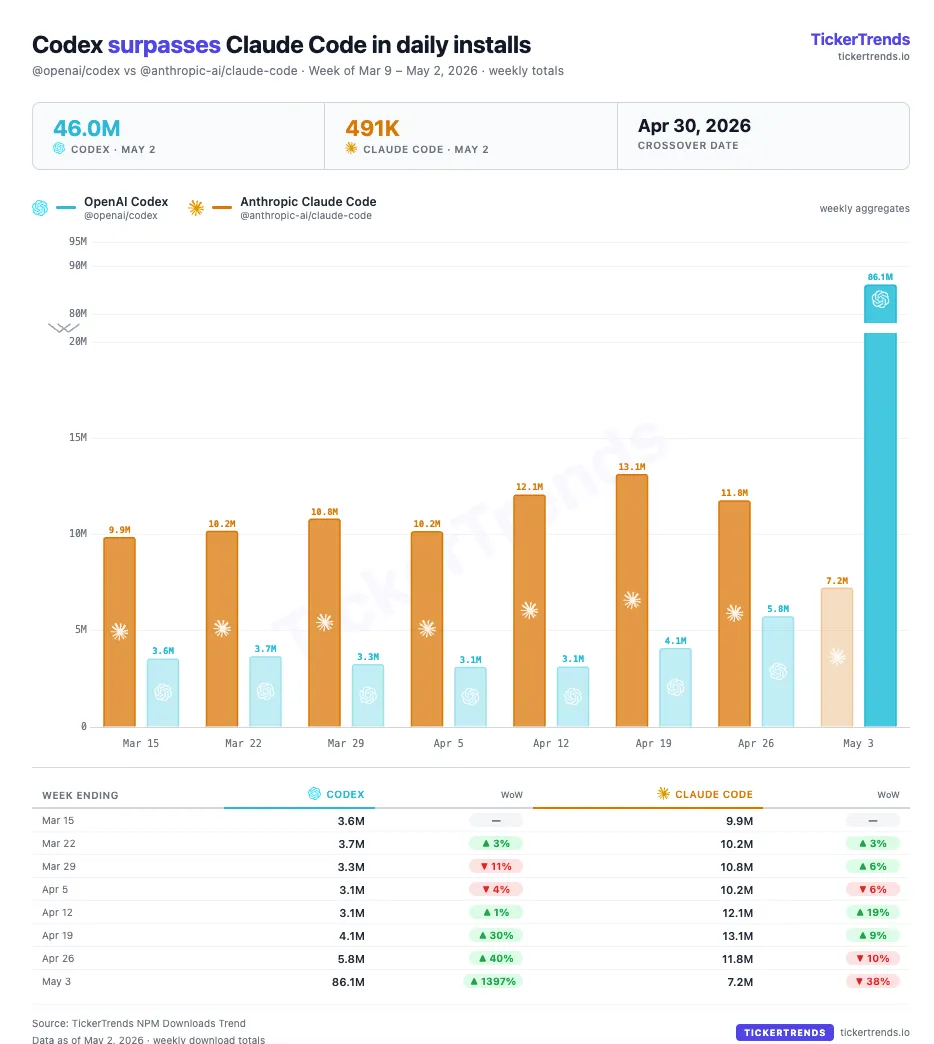
The service records the number of npm package downloads for the Node.js platform, not the number of unique application users.
In mid-April, OpenAI released a major update to Codex. The AI agent for programming gained the ability to use applications on a computer: it can see the screen, click the mouse, and enter text.
An integrated browser was added to the application, where users can leave precise instructions for the assistant directly on the pages.
On April 30, the company launched the /goal command—an analogue of the Ralph Loop plugin in Claude Code. This feature allowed Codex to plan and execute multi-step tasks across several sessions.
On May 1, Codex introduced “pets”—a kind of “Tamagotchi” displaying the activity and status of the AI agent.
Anthropic’s situation is different. At the end of March and beginning of April, Claude users began to complain about bans—including paid accounts. Reasons included connecting OpenClaw and registering from an unsupported region.
Users also report increased token consumption. This is linked to the new tokenizer and the implementation of “adaptive thinking.”
Back in early April, shares of AI startup Anthropic became the most sought-after on the secondary market, while OpenAI’s stocks lost appeal to buyers.
Рассылки ForkLog: держите руку на пульсе биткоин-индустрии!