




Pulitzer Prize winner John Carreyrou from the NYT has suggested that British cryptographer Adam Back might be the creator of Bitcoin, Satoshi Nakamoto.
The mystery of Satoshi Nakamoto, the pseudonymous inventor of Bitcoin, has remained unsolved for 17 years. Not anymore. Read my 18-month investigation to find out who Satoshi really is. https://t.co/fPtaK6YHJC
— John Carreyrou (@JohnCarreyrou) April 8, 2026
The journalist analyzed thousands of posts by cypherpunks and found similarities in writing style that pointed to Back. Carreyrou also examined hundreds of court records and emails. The investigation took 18 months.
The impetus was a 2024 documentary Money Electric: The Bitcoin Mystery. In one scene, Back sat on a bench in a Riga park and tensed when the director named him as a possible creator of the first cryptocurrency.
Carreyrou, claiming to be adept at detecting lies, found the cryptographer’s behavior suspicious.
Cypherpunk Posts
The investigator delved into the archives of the cypherpunk mailing list — Back had participated since 1995. Based on 134,308 messages from 620 participants, he built a database and used linguistic analysis (hyphenation errors, spelling variations) to narrow it down to one person.
The main clue was posts from 1997, where the cryptographer described all five key features of Bitcoin. Back proposed an electronic money system that would be “completely disconnected” from modern banks, maintain payer and recipient confidentiality, operate in a distributed network, have built-in scarcity, and not require trust in any organization.
At that time, it was still 10 years before the publication of the digital gold white paper.
According to Carreyrou, Back also anticipated the solution to the Byzantine Generals Problem, described nodes capable of “coming and going” without harming the network, and suggested using his Hashcash for minting Wei Dai’s b-money. Later, Satoshi mentioned both technologies in the white paper.
Linguistic Analysis
Carreyrou analyzed Satoshi’s language — vocabulary, spelling, punctuation, habits. By these measures, Back was closest to the texts of Bitcoin’s creator.
For instance, both placed two spaces between sentences — a typographic habit indicating an older author. Nakamoto and Back also used the interjection bloody (characteristic of Britons).
Later, the cryptographer denied using this word, but the journalist found his 1998 post with the same bloody and saw it as an attempt to conceal linguistic similarity to Satoshi.
The main linguistic argument was chaotic hyphenation. This was not a single error but a consistent pattern:
- e-mail / email;
- built-in / built in;
- off-line / offline;
- pre-compiled / precompiled.


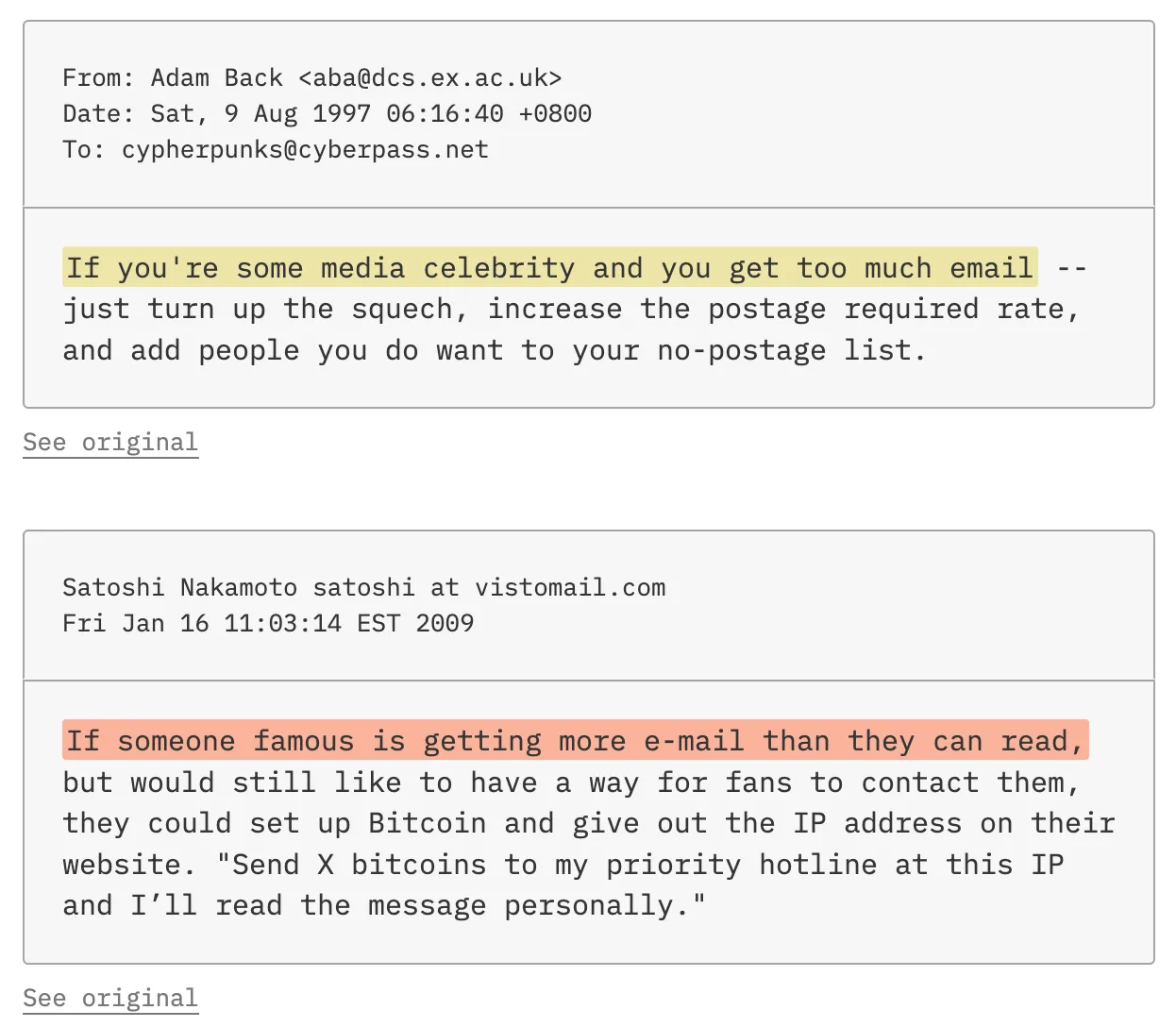
Both also mixed British and American forms (cheque / check) and wrote technical words together (backup, bugfix). Such things are harder to fake than word choice, noted Carreyrou.
Before Satoshi, the term Proof-of-Work with hyphens as a compound noun was used by only eight people in the mailing lists. After narrowing by another rare feature — mentioning WebMoney — only one remained: Adam Back.
The phrase burning the money in the sense of destroying electronic currency was used only by Back before Satoshi. The expression partial pre-image appeared with two people (Hal Finney and Back), but it was Back who hyphenated it as Satoshi did.
Other Clues
Carreyrou found the timing of Back’s public activity particularly suspicious. A person who had discussed electronic money, privacy, and distributed networks for years virtually disappeared from the discussion just when Satoshi emerged. Then he began actively participating in the Bitcoin community after Satoshi’s disappearance.
The journalist described this as a possible division of roles: while one persona acts as Satoshi, the other public mask — Adam Back — remains silent.
In 2013, the cryptographer appeared at a Bitcointalk conference precisely when an analysis of Satoshi’s state was released. Two years later, his position in the block size debates almost verbatim repeated Back’s arguments.
The investigator doubted the authenticity of Satoshi’s emails to Back, usually considered exculpatory. The latter never provided their metadata, which could confirm the correspondence’s authenticity.
Back’s Reaction
Following the publication of the investigation, Back denied Carreyrou’s suggestions. He reiterated that he is not Satoshi but acknowledged his active role in the cypherpunk movement.
i’m not satoshi, but I was early in laser focus on the positive societal implications of cryptography, online privacy and electronic cash, hence my ~1992 onwards active interest in applied research on ecash, privacy tech on cypherpunks list which led to hashcash and other ideas.
— Adam Back (@adam3us) April 8, 2026
The cryptographer called the coincidences found by the journalist “a combination of chance and recurring phrases among people with similar experiences and interests.” He also pointed to a possible confirmation bias due to his large volume of messages:
“I wrote 20 times more than others, so statistically I have a higher chance of random coincidences. I suggested John adjust for this as a possible confirmation bias.”
Back in February 2025, deBanked editor Sean Murray named Block co-founder Jack Dorsey as Bitcoin’s creator. He compiled an impressive list of facts, dates, and coincidences allegedly supporting his theory.