



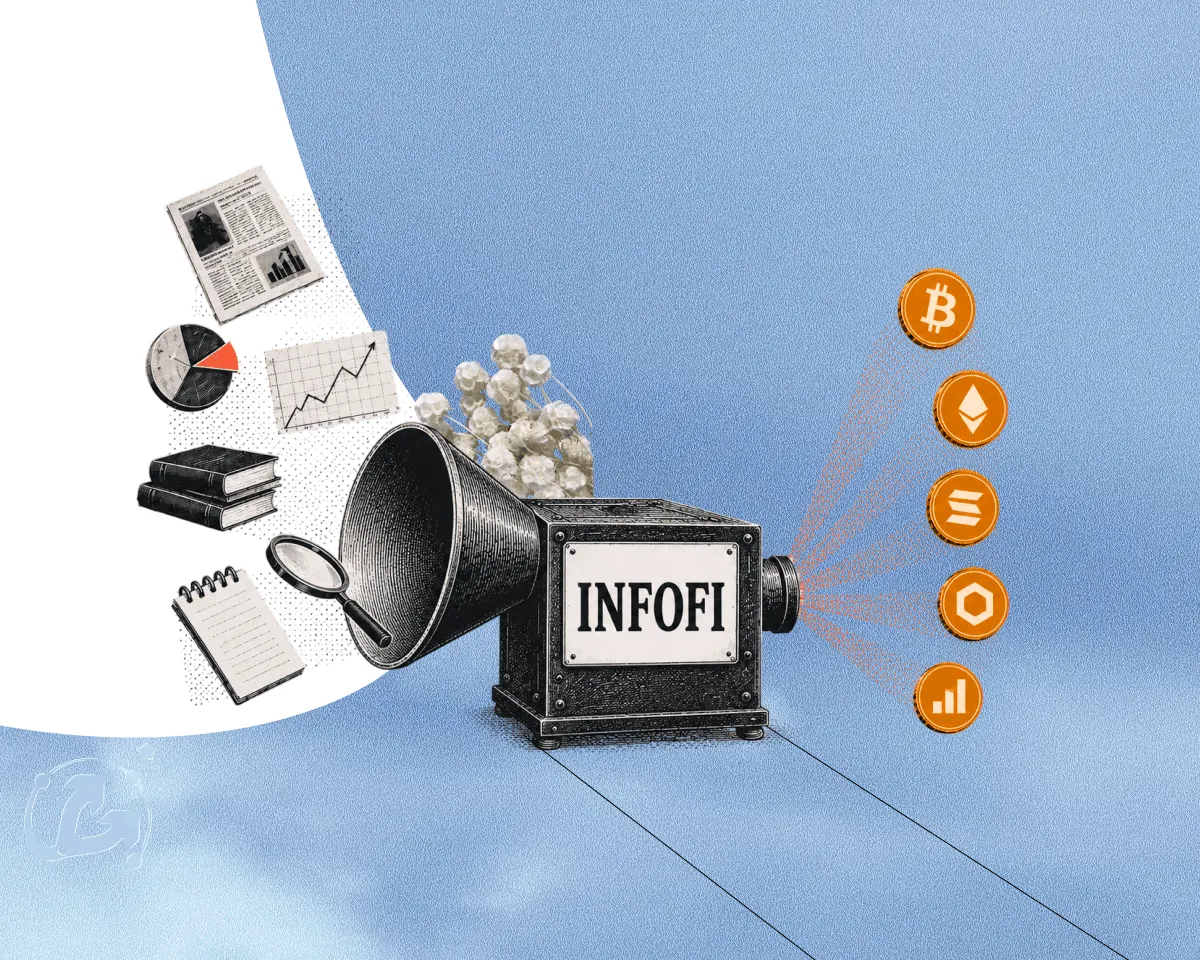
The InfoFi segment saw a dizzying ascent, accusations of spam and a clampdown from social network X. Projects that promised to monetise information hit a crisis, and their tokens plunged. Yet the narrative of InfoFi’s “death” may be premature. ForkLog examines what actually happened to the segment and in what form it may return.
From a niche idea to a standalone category
InfoFi is an approach that turns information into a tradable financial asset. Blockchains ensure transparency of data provenance, and tokenisation gives it a market price. Unlike in traditional finance, where information merely informs decisions, here the signal itself becomes the asset: one can tokenise social engagement, analytical reports, prediction outcomes and even an author’s reputation.
The logic is simple: crypto markets move on narratives, research and timing, but most of the revenue from these flows has traditionally accrued to platforms, insider chats, exchanges and big accounts with distribution. InfoFi was conceived as a mechanism for redistribution: the reward goes to those who generate useful signals, not those who simply own them.
The Kaito team set out an even starker thesis: attention is a scarce resource that is currently allocated by opaque algorithms. Make it measurable and tradable, and capital will flow to quality content automatically.
What the sector is made of
In its mature form, InfoFi rests on several building blocks. First, tokenised data: engagement, authors’ reputations and the results of their forecasts are stored on-chain and can move across protocols. Second, prediction markets, which serve as pricing oracles for real-world events. Third, AI agents that aggregate disparate signals into structured indices.
It is this “data + market + artificial intelligence” triad that sets InfoFi apart from classic social tokens and paywalled subscriptions. Information ceases to be a by-product and becomes a primary asset with an intelligible demand curve.
Clash with X
In January, X updated its rules and banned apps that pay users for posts, mentions or other activity on the platform. Kaito, Cookie DAO, Loudio and several other services building Post-to-Earn models on top of X were caught up in the change.
The formal trigger was a post by X’s head of product, Nikita Bier. He argued that financial incentives for posting distort the feed and clog the platform with low-quality content. After his statement, the accounts of key InfoFi projects were restricted, and integrations via API were revoked.
We are revising our developer API policies:
We will no longer allow apps that reward users for posting on X (aka “infofi”). This has led to a tremendous amount of AI slop & reply spam on the platform.
We have revoked API access from these apps, so your X experience should…
— Nikita Bier (@nikitabier) January 15, 2026
The community’s reaction was unexpectedly measured. Some authors accepted the criticism: gamifying attention did spawn a wave of templated threads and cookie-cutter “analysis” posts. Others noted that low-quality content pre-dates InfoFi — YouTube, TikTok and Instagram reached clickbait without any crypto incentives. Platforms design behaviour with reward economics and then feign surprise at the outcome.
The upshot was that X closed a period when influence on the social network could be earned in a measurable and transparent — if imperfect — way. For InfoFi projects, it underlined a simple point: relying on a single centralised platform is a strategically fragile model.
January’s token slump
The consequences showed up in prices. In January, key sector tokens lost about 20% in short order. KAITO, COOKIE, DAO Maker and related assets fell in tandem as the market repriced the risks of dependence on X’s infrastructure.
Analysts dubbed it a moment of innovate or die. Investors began to separate teams capable of building autonomous value around information curation from those whose product rested entirely on one social network’s API. Projects with diversified data sources — Farcaster, on-chain activity, prediction markets — suffered less.
Notably, by spring KAITO had partly recovered and trades around $0.5, while DAO Maker posted weekly gains north of 35% at times. The sector was not “wiped out” — it went through a painful but predictable compression.
Why talk of InfoFi’s demise is premature
“InfoFi is dead” makes for a punchy line but a poor description of reality. The underlying problem remains: crypto still moves on narratives, and the value of information still accrues to platforms and insiders rather than to those who produce it.
The idea is not changing — the implementation is. The first wave of InfoFi was experimental and often amounted to the “financialisation of tweets”. The second wave focuses on more fundamental tasks: source verification, on-chain reputation, AI-led data aggregation and integration with prediction markets. The hype recedes; the applied layer remains.
Prediction markets are instructive. In early 2026, Polymarket, Kalshi and similar venues effectively turned into rapid financial data feeds — contract prices reflect events before traditional media can publish. Analysts describe this as forecasting platforms becoming a “truth machine” for macroeconomics, politics and corporate events.
This is no longer about getting paid for posts, but about an infrastructure layer plugged into hedge funds, media and algorithmic traders. Formally, such venues are part of InfoFi, but their business model does not depend on X’s favour.
Where the segment is heading
InfoFi’s current state can be summed up in three processes.
- Decoupling from centralised social networks. Teams are migrating to Farcaster, Lens and their own on-chain infrastructure. Farcaster’s protocol model is a natural refuge — there is no single owner who can switch a project off with one post.
- A shift from quantity to quality. mindshare and Yap-to-Earn give way to systems where reputation accrues over years and is validated by forecasting results, not posting volume. AI agents help filter bots and templated content.
- Consolidation around a few working paths: prediction markets as a data source, on-chain analytics with tokenised reputation, and AI sentiment indices for DeFi strategies. The rest either integrates into these three or exits.
What this means for participants
For authors and analysts, InfoFi remains a way to monetise signals directly — but not through quick payouts for activity. Durable income now demands a verifiable track record.
For investors, this is a high-dispersion sector: winners and losers are determined by a team’s ability to operate irrespective of any single platform’s policy. KAITO remains a benchmark, but no longer the only bet.
For the industry, InfoFi has been a useful lesson in platform risk. A decentralised economy built atop a centralised API is, by definition, vulnerable — a conclusion that reaches well beyond information finance and applies to any Web3 product reliant on Web2 infrastructure.
InfoFi has neither vanished nor triumphed. The sector has moved from loud experiments to slow engineering — and that is where its true shape is being forged.