




Bitcoin is weathering the Iran crisis better than major precious metals, JPMorgan analysts have concluded, reports The Block.
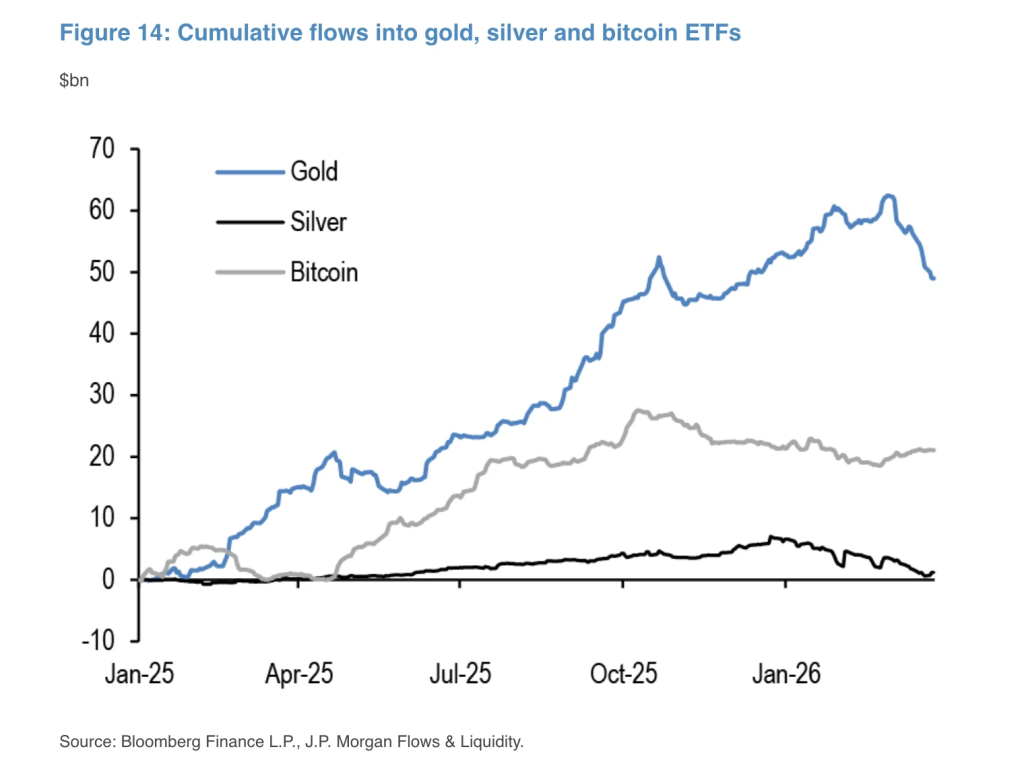
Since early March, gold has fallen 15%. Rising interest rates and a stronger dollar have weighed on an overheated market. According to the bank’s experts, record highs (gold — $5,500, silver — $120) left these assets vulnerable to mass profit-taking and liquidations as conditions shifted.
Over the past three weeks, gold exchange-traded funds have lost about $11 billion. Silver ETFs shed all the assets accumulated since last summer. Over the same period, bitcoin-based vehicles attracted $1.3 billion.


Liquidity recovers
After the outbreak of the conflict, crypto activity in Iran surged: locals moved funds off domestic exchanges to non-custodial wallets and international platforms.
In global markets, bitcoin open interest jumped to $30 billion, CryptoQuant noted.
Open interest surged to ~$30B as prices rallied.
Binance led inflows, with BTC +$829M and ETH +$1.6B, while activity concentrated on top exchanges.
Leverage is flowing into major venues, not broad market participation. pic.twitter.com/uTolRnxtVU
— CryptoQuant.com (@cryptoquant_com) March 26, 2026
Inflows concentrated on the largest venues: Binance saw $829 million in bitcoin and $1.6 billion in Ethereum, while activity on smaller exchanges remained muted.
Institutional positioning also shifted. JPMorgan’s proxy indicator (based on open interest on CME) showed accumulation in gold and silver in late 2025 to early 2026, then began to fall from January. Positioning in bitcoin futures remained stable.
Trend-following traders amplified market moves. Signals for precious metals fell from overbought into sub‑neutral territory — consistent with liquidations. For bitcoin, by contrast, signals have been recovering from oversold toward neutral, reflecting improving sentiment.
The liquidity mix shifted, too. Gold — historically more liquid than silver and bitcoin — ceded market breadth to the first cryptocurrency. Silver dropped the most, which, JPMorgan analysts said, may have further magnified the asset’s price swings.
Network activity cools
At the same time, CryptoQuant analyst Carmelo Aleman flagged a decline in on-chain activity. The number of active bitcoin addresses fell by 30% — from 938,609 to 655,908 — the lowest since August 2025.
Bitcoin Is Cooling Internally: Active Addresses Have Fallen by More Than 30%
“To validate a convincing structural recovery, it will not be enough to see price move higher; network activity will also need to return.” – By @oro_crypto pic.twitter.com/eBMkEcCut5
— CryptoQuant.com (@cryptoquant_com) March 27, 2026
The seven-day moving average of active addresses fell from 777,283 to 612,972 (-21.14%), and the 30-day from 743,714 to 636,314 (-14.44%).
A bear market exacerbates this metric, the expert noted. Falling prices and fewer active addresses suggest the market is losing not only value but real participants.
“This is important because a price increase by itself does not validate a structural recovery. As long as on-chain activity remains weak, any upswing will rest on a more fragile foundation than during periods of genuine expansion,” Aleman emphasized.
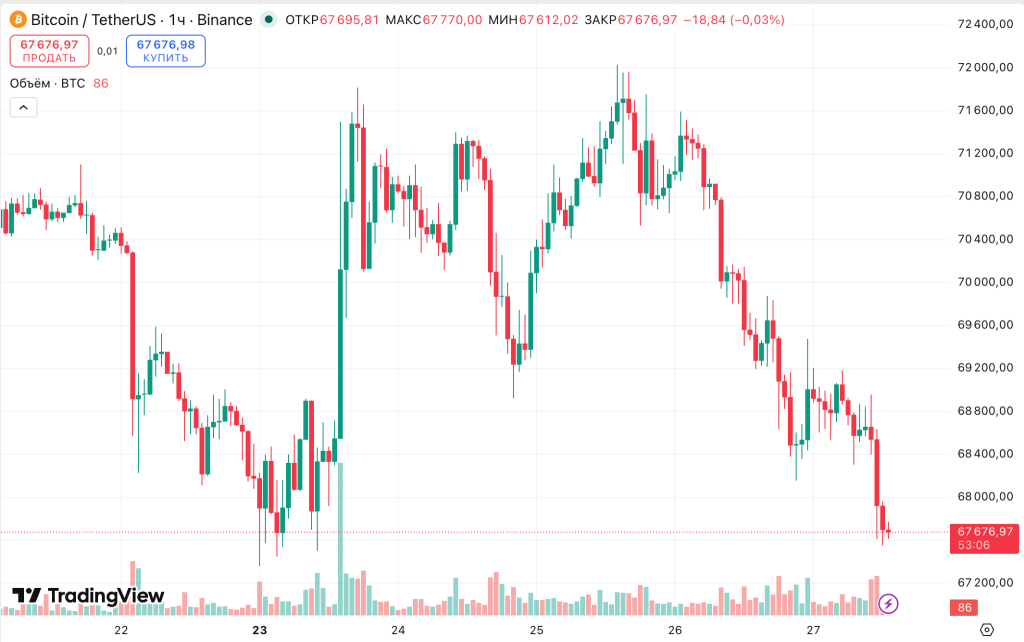
At the time of writing, bitcoin trades around $67,700. Over the past 24 hours, the price is down 2.7%.


On March 27, Deribit’s quarterly options expiry totalled $13 billion for bitcoin and $2.1 billion for Ethereum. The put/call ratio was 0.56, indicating a notable tilt toward bullish bets.
🚨 Quarterly Options Expiry Alert | 08:00 UTC Friday
$15.58B in crypto options are set to expire tomorrow on Deribit. The largest expiry in 2026 so far.$BTC: 195,398 contracts | $13.46B notional | Max pain: $75K | Put/Call: 0.61$ETH: 1,026,462 contracts | $2.12B notional |… pic.twitter.com/Ap70thX9dI— Deribit (@DeribitOfficial) March 26, 2026
On March 24, an analyst under the moniker Sykodelic outlined a condition for bitcoin to climb to $200,000. In his view, to set a new all-time high the coin must close a weekly candle above $74,400.