



Freedom, not decentralisation
A dilemma of internet democracy
Among privacy advocates and champions of free information, centralisation is commonly seen as the problem. Cypherpunks and enthusiasts have spent decades building decentralised alternatives; technologically, free money, communication and information already exist. Yet the egalitarian digital utopia never arrived: the mainstream still belongs to the centralised products of IT behemoths.
In her essay The Federation Fallacy activist and developer Alyssa Rosenzweig argues that the key to freedom in the information age is neither centralisation nor decentralisation, but ideas of digital democracy.
This piece examines how the evolution of government maps onto online platforms—and why, even on the internet, anarchy is no answer to tyranny.
Centralisation is natural
The average user of the open internet has tools to build personal information freedom and privacy. With some caveats, one can even achieve a degree of financial independence.
A decentralised internet
The internet remains, technically, a decentralised and open system to which anyone may connect. Anyone can spin up a server and a website. Many organisations maintain infrastructure and offer services to businesses and users. No single entity can, at will, control the system in its entirety.
Yet one clumsy move in an Amazon or Cloudflare server room can reverberate on a planetary scale, and access to the internet itself may become an unattainable privilege at the whim of the authorities in some countries.
Open email
Email is also a decentralised system. Anyone may run a personal server and be responsible for their own correspondence. Most people cannot—or do not wish to—cope with the technical complexities and the costs of maintaining infrastructure.
Google has already set up the servers and offers a ready-made free service. It comes with spam filters, access to a whole ecosystem of products and the ability to tie your digital life to one account. You can, however, register your own domain and master the nuances of SPF, DKIM and DMARC.
Open messaging
Jabber (the XMPP protocol) is likewise an open solution for online chat. You can run your own server that federates with other XMPP servers in full self-governance.
But the bulk of participants in this protocol are WhatsApp users, confined within the service. The app does not allow messaging with other XMPP systems.
Mainstream centralised services offer convenience without technical know-how or costs. Free, decentralised alternatives remain the preserve of enthusiasts with specialist skills.
In such conditions Gmail, WhatsApp and other giants naturally remain the default for the vast majority of users.
Mastodon’s failed success
In Rosenzweig’s view, Mastodon—a decentralised rival to X—is one of the most promising examples of a federated system true to the ideals of freedom and decentralisation.
Many independent instances interoperate under one protocol, and any user can create a new server for friends or colleagues.
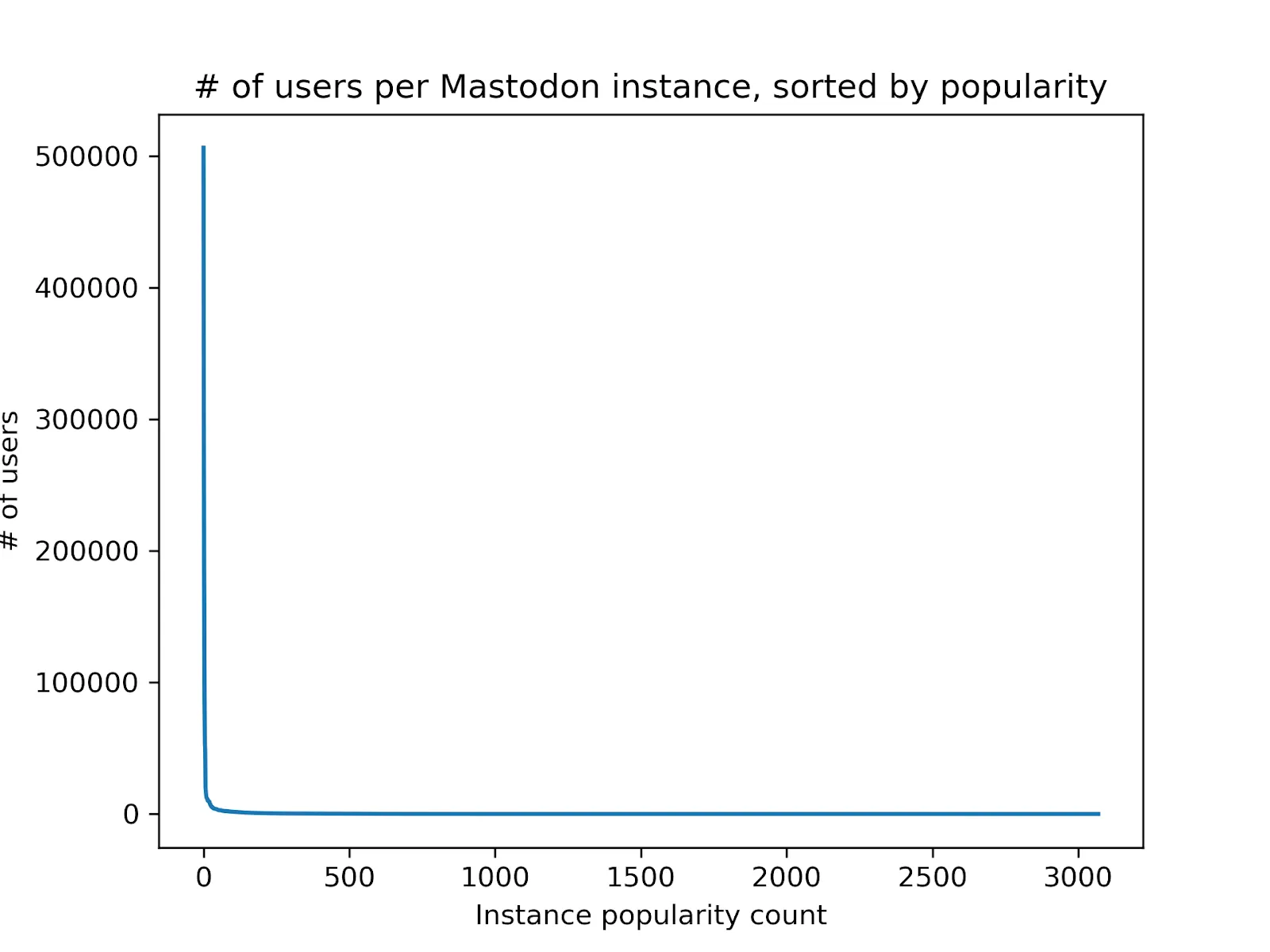
In 2019 Rosenzweig analysed the Mastodon data then available. On average, each of 3,070 servers had 640 users. The distribution, however, was uneven.
The three largest instances covered 50.8% of users. Just two accounted for 41.2%.
The Mastodon developers’ site lists more than 7,000 active instances with roughly 745,000 users as of March 2026. All have voluntarily agreed to the platform’s “code of honour”: to actively moderate problematic content and uphold safety.
Meanwhile, the FediDB service counts the majority of registered servers and accounts: by its tally, there are over 9,000 and 8.5m, respectively.
The flagship instance mastodon.social counts 284,000 active users.
Other large communities include: mstdn.jp — 413,167 registered accounts; mstdn.social — 271,540; mastodon.world — ~195,100; mastodon.cloud — ~189,000; mastodon.online — ~189,000; mas.to — ~188,000; techhub.social — ~86,000; infosec.exchange — ~80,000.
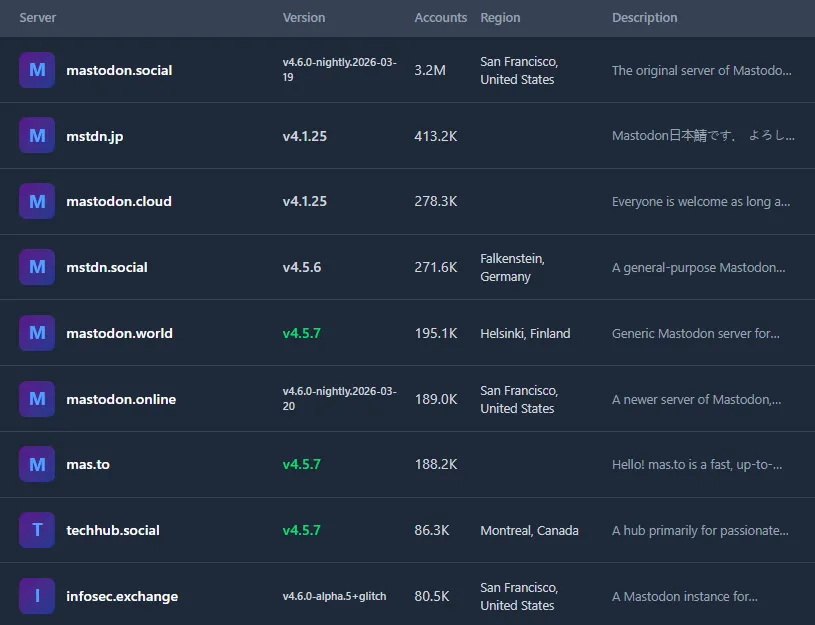
Rosenzweig argues that such consolidation marks a failure for Mastodon by the yardstick of decentralisation. In an ideal world, figures would sit closer to the arithmetic mean, and each of the thousands of servers would be a trusted community of users who know one another.
In practice, even technically decentralised systems sprout large centres of gravity around which users and resources concentrate.
The result: in decentralised email there emerges Gmail; the XMPP technology led to centralised messengers such as WhatsApp; and corporations took charge of the World Wide Web.
Centralisation is necessary…
Describing the search for a realistic form of digital freedom, Rosenzweig turns to political history and the metamorphoses of states on the road to democratic society.
The starting point is authoritarianism. Its online analogue is an internet under the sway of Silicon Valley giants—a kind of “digital dictatorship”.
Toppling it ushers in a period of anarchy—naive decentralisation in which everyone bears individual responsibility for their data and freedoms.
This is a “bloody and short life”. Moreover, sooner or later the whole system risks collapse through the tragedy of the commons or the paradox of tolerance.
The natural vector is towards some form of “order” and consolidated control. For Rosenzweig, naive anarchic decentralisation need not rebuild a smashed dictatorship or nourish techno-oligarchs. The alternative can be digital democracy.
…but in moderation
As European states show, a centralised democracy is no ideal—but it is a viable compromise.
A certain degree of centralisation is necessary. It is the basis for an efficient administrative apparatus. Anyone can entrust control to an “administrator” and gain access to the system.
The key is that, under centralisation, the controlling entity remains accountable to users rather than to the self-interest of developers or corporate owners.
Rosenzweig sketches her view of digital democracy with a microblogging platform. There is a flagship server with clear rules adopted via public consensus. When needed, those rules are enforced by a moderation team elected by the community.
The platform’s code should be open, and all functions available through an API. Users can then choose among different client apps and avoid lock-in to any official product.
The developer stresses that many of these traits are largely realised in Mastodon. Hence, despite failure by decentralisation’s standards, the project can be seen as a success of digital democracy.
Rosenzweig sees “Wikipedia” as another vivid, large-scale example. Despite significant centralisation, the project’s freedom is upheld by democratic principles and processes. Anyone can make edits, within limits, and conflicts are resolved by seeking consensus.
Freedom through accessibility
A viable system worth striving for will be a compromise between centralisation and freedom. It must be accessible to all, regardless of wealth or technical expertise.
The commercial interests of large corporations run counter to users’ interests. The technical barrier to building one’s own digital infrastructure denies mass consumers the benefits of decentralisation.
“Whether online or in the real world, to attain freedom it is not enough simply to reject dictatorship. We must support democracy,” concluded Rosenzweig.
As in real life, the path to democracy will be anything but easy. Perhaps it can be built despite the dictatorship of technology giants and through the naive anarchy of decentralisation.
Even there, beyond the threshold of utopia, a free system will require active upkeep. Unfortunately, in the digital world, as in the real one, democracy easily turns against itself.
Text: Krzysztof Szpak
Рассылки ForkLog: держите руку на пульсе биткоин-индустрии!