




Infrastructure startup Eureka Labs has secured $6.7 million in seed funding to advance its concept of ‘programmable blocks’ for Ethereum, reports The Block.
This novel approach transforms blocks from ‘passive containers’ into active execution environments.
Typically, such structural elements merely package and order transactions. According to project leader Nir Magenheim, the system’s architecture allows for on-the-fly logic implementation.
The following features become available:
- intra-block credit — users can obtain unsecured loans within a single block, provided they are repaid before finalization;
- state-aware pre-computation — conducting complex operations during the assembly phase based on the precise state of the network. Developers claim this approach reduces fees and enhances overall system stability;
- execution-time external data access — real-time integration of off-chain information during execution;
- deterministic transaction placement — ensuring transactions are executed in a strictly defined sequence.
“This allows for block-level guarantees, not just within smart contracts. For instance, applications can be developed that require significant funds for a few seconds, strict operation sequences, or complex computations unsuitable for direct on-chain execution,” Magenheim emphasized.
He stated that these new features will enable the development of more advanced trading strategies, efficient DeFi protocols, and a new type of decentralized applications.
Business Model
The Eureka project is based on the PBS architecture within the Ethereum network. In this concept, block formation is handled not by validators, but by a separate category of participants — specialized builders.
Magenheim is confident that over time, these operators will become a new execution layer for the blockchain, similar to how smart contracts once expanded the network’s basic capabilities.
The startup’s business model is built on collecting fees from transactions added to the formed blocks.
Eureka’s headquarters are in Tel Aviv, and the team consists of 12 people. The company recently opened a research center in Poland and is now actively expanding the staff of both divisions.
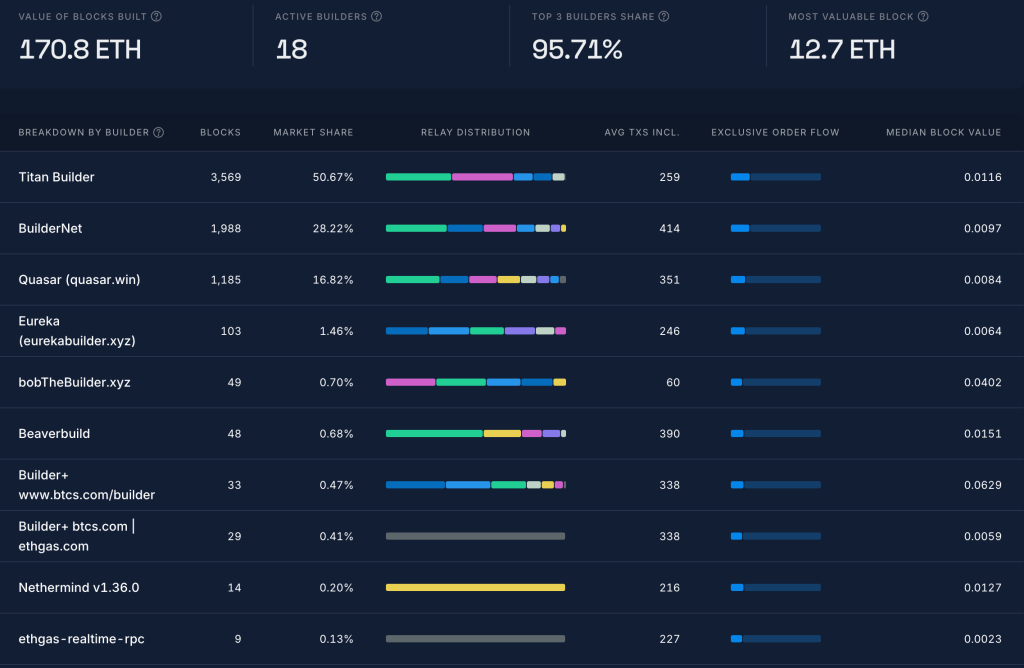
According to Rated Network data, the project began operations in December 2024 and has already become the fourth-largest Ethereum builder by the number of blocks created. However, the company’s market share remains modest at 1.5%, while nearly 96% of the segment is controlled by niche leaders: Titan Builder, BuilderNet, and Quasar Builder.


Investments
The funding round was led by venture firms Spark Capital and Collider Ventures. Other investors include Varrock Ventures, Node Capital, Reverie, Very Early Ventures, Atka, Synergis, Masterkey, and several angel investors, including CoinList President Scott Keto.
As part of the agreement, Collider Ventures founding partner Avishai Ovadia joined Eureka’s board of directors.
According to co-founder and CEO Nir Magenheim, the capital was raised in two tranches: $4.7 million in April 2025, and the remaining $2 million from Spark Capital in June. The deal was structured as a SAFE with token warrants.
Earlier, the Ethereum Foundation introduced a new vision for the roles of the base layer and rollups, shifting the focus from scaling to differentiation.