



Bitcoin Developer Introduces Quantum Threat Protection for Wallets
Olaoluwa Osuntokun, CTO of Lightning Labs, has unveiled a prototype tool to protect Bitcoin wallets.
Olaoluwa Osuntokun, the Chief Technical Officer of Lightning Labs, has unveiled a prototype tool designed to protect Bitcoin wallets from potential quantum attacks.
in the face of quantum adversary, a commonly discussed emergency soft fork for Bitcoin would be to disable the Taproot keyspend path (https://t.co/Gzx8NVui3N), effectively turning it into something that resembling BIP-360
assuming an existing precautionary soft-fork to add a pq…
— Olaoluwa Osuntokun (@roasbeef) April 8, 2026
The Problem
Bitcoin employs encryption algorithms that are theoretically vulnerable to powerful quantum computers. If breached, public data on the blockchain could allow the computation of private keys, leading to the theft of digital gold holdings.
To counter this threat, developers have proposed a protection plan. Initially, a voluntary migration: BIP-360 introduces a quantum-resistant type of wallet. Users can transfer coins to new addresses in advance.
However, migration takes time, and not all holders of digital gold will adapt in time. Moreover, the network contains old wallets with permanently lost access.
As a last resort, an emergency brake mechanism is provided: the blockchain will disable the current signature system to block the possibility of asset theft.
The main issue is that most modern addresses, including the Taproot format, rely solely on this signature system. If blocked, legitimate owners will lose the ability to confirm ownership of their funds.
The Solution
Osuntokun’s solution offers an alternative for those who have not migrated but are not caught in the “emergency brake” trap.
His system, based on zk-STARK, replaces the digital signature: the owner confirms wallet creation through a secret seed phrase without revealing it. This ensures that rescuing one address does not compromise others generated from the same phrase.
The prototype is already operational. On a powerful MacBook, proof generation took about 55 seconds, while verification took less than two seconds. The proof file is approximately 1.7 MB (similar to a high-resolution photo).
Osuntokun noted that the system was developed as a side project and is not yet optimized. There is no formal proposal for integrating the tool into the Bitcoin network, nor any timeline.
Bernstein’s Forecast
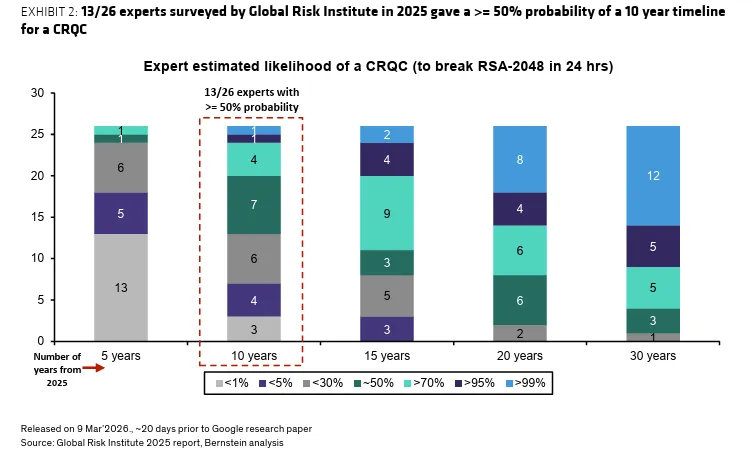
The team of analysts at Bernstein, led by Gautam Chhugani, described quantum computing as a “manageable upgrade cycle” rather than an “existential risk” to the first cryptocurrency.
Recent research by Google indicated that significantly fewer resources might be needed to break Bitcoin’s cryptography than previously thought. However, creating a super-powerful computer remains years away due to technical challenges and high costs.
According to Bernstein, the crypto industry has three to five years to prepare. This time should suffice to transition to quantum-resistant standards.
Adam Back, CEO of Blockstream, expressed a similar view in an interview with Bloomberg. He explained that Google’s paper only addressed algorithm improvements, not hardware progress.
The expert stated that current quantum systems remain “extremely primitive” due to error correction limitations. He noted that even the most advanced demonstrations are trivial compared to what is needed to break Bitcoin’s cryptography.
“The most complex calculation it performed was factoring the number 21 into seven multiplied by three. Something children in elementary school can do,” Back remarked.
In April, Zach Pandl, head of research at Grayscale, described Bitcoin’s quantum problem as more social than technical.
Рассылки ForkLog: держите руку на пульсе биткоин-индустрии!