



Bitcoin climbed to $78,000 for the first time since early February after Iran’s foreign minister, Abbas Araghchi, said the Strait of Hormuz had reopened.
In line with the ceasefire in Lebanon, the passage for all commercial vessels through Strait of Hormuz is declared completely open for the remaining period of ceasefire, on the coordinated route as already announced by Ports and Maritime Organisation of the Islamic Rep. of Iran.
— Seyed Abbas Araghchi (@araghchi) April 17, 2026
At the time of writing, bitcoin trades around $77,900, up 5% over the past 24 hours.


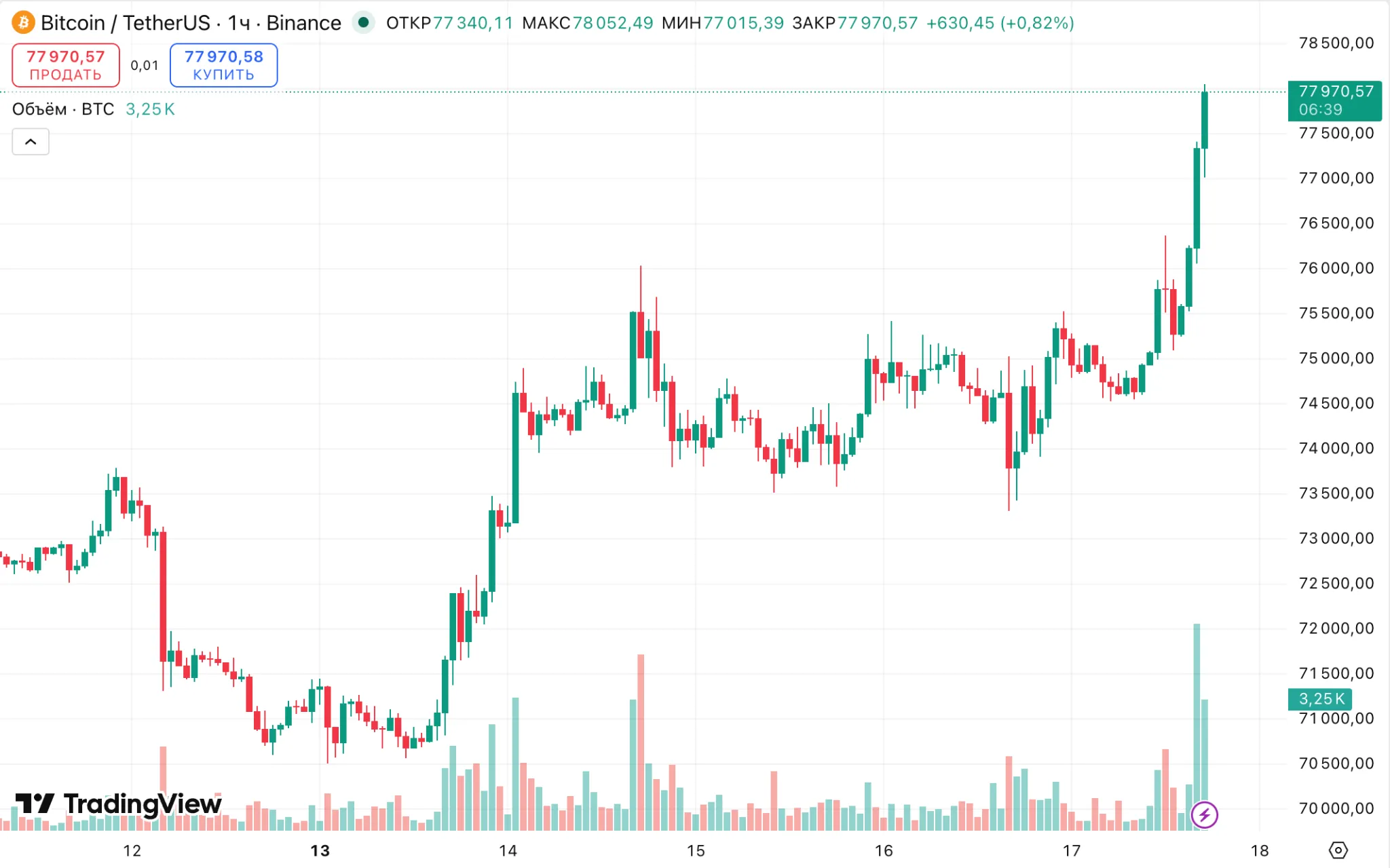
Earlier, Glassnode noted that confirming a bull trend would require a break above $78,000 — the level of the realised market price.
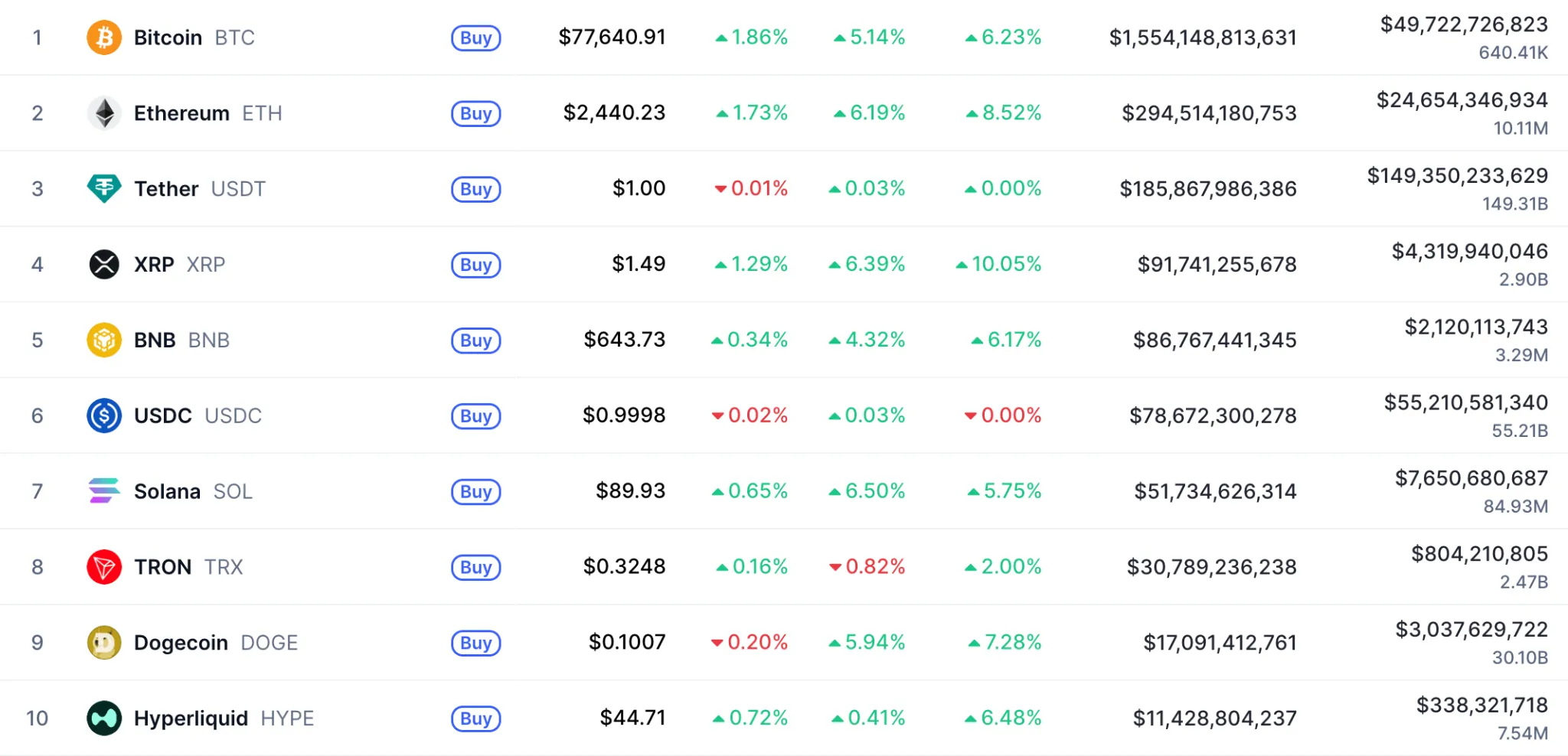
The broader market followed. Ethereum jumped 6% to $2,400. XRP added 6.3%, Solana — 6.5%.

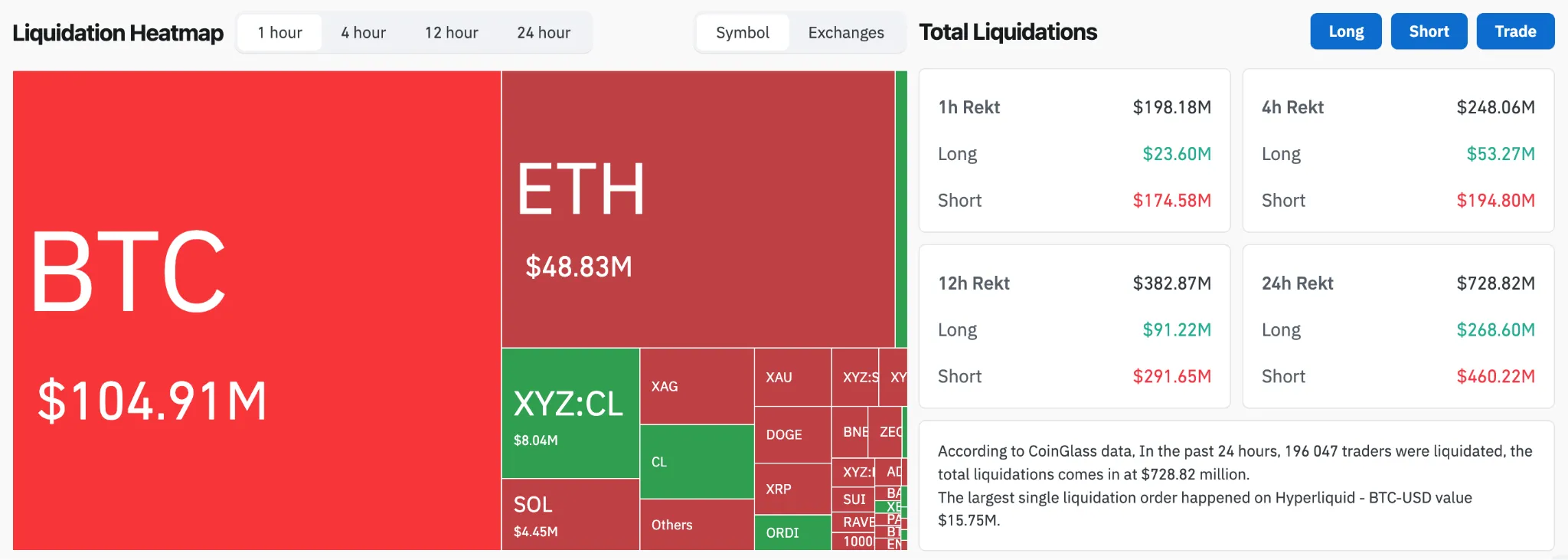
Amid the rally, liquidations nearly reached $200m in an hour, with $171m of that from shorts. The daily tally hit $728m.

Araghchi wrote that commercial vessels will be able to transit the strait for the duration of the ceasefire between Israel and Lebanon. The ten-day truce was reached the day before, on April 16.
US President Donald Trump confirmed the reopening of Hormuz, adding that the US naval blockade of Iranian ports will continue until talks with Tehran conclude.
According to the US leader, the parties have agreed on most of the deal’s points, so the process “should move very quickly”.
Oil and equities react
The Iranian foreign ministry’s announcement pressured energy prices. Brent fell 10% — to $89 — while WTI slid almost 11% — to $84. At the outset of the Middle East conflict and after the closure of the Strait of Hormuz, fuel prices had topped $100.
US stocks cheered the news. The S&P 500 returned to record highs and, for the first time since late January, exceeded 7,000 points. The Nasdaq also broke its ATH.
Technology firms led the rally, wrote Bloomberg. Analysts said retail investors have looked past the war with Iran and started snapping up AI and innovation stocks.
“After the ceasefire announcement, the focus quickly returned to artificial intelligence and other technology themes, and the stocks popular with retail investors — especially the most volatile — started leading the market up from local lows,” said Dave Mazza of Roundhill Investments.
Even so, conditions remain “fragile”, analysts reckon. Oil has yet to return to prewar levels and in March posted its biggest monthly gain since 2022. The consequences for the Persian Gulf’s energy infrastructure remain unassessed.
“The problems in the Middle East and in the private-credit market have not gone away, so this kind of action is definitely worrisome,” warned Matt Maley of Miller Tabak.
What it means for crypto
MN Trading founder Michaël van de Poppe expects bitcoin to rise alongside equities, pointing to the Nasdaq, which has risen 12 days in a row.
The Nasdaq is up 12 days in a row.
Only a few occassions we’ve seen this happening.
What does that mean for $BTC?
Why is $BTC not following with the same strength?#Bitcoin is definitely broken and lost its premise!In this post, I’ll give some statistical data on what I… pic.twitter.com/HRA1NQ21DD
— Michaël van de Poppe (@CryptoMichNL) April 17, 2026
Such episodes — when the index staged a powerful rally while digital gold was in a relatively mature phase — occurred only twice: in July 2013 and July 2017. In both cases, bitcoin later followed the Nasdaq:
- in 2013, the asset’s price rose by 1,000% six months after the index peaked;
- in 2017, it jumped by 400%.
In previous, milder Nasdaq upswings, bitcoin lagged by two to three weeks before outperforming by four to six times.
“My base case: we’ll see a rally to $85,000–88,000 as a first test, but if the Nasdaq keeps rising, I wouldn’t be surprised if bitcoin aims for all-time highs in the fourth quarter of 2026,” van de Poppe forecast.
Other analysts are more circumspect about the market’s next leg. According to the commentator known as Darkfost, conditions remain highly unstable and speculative, with futures reacting sharply to each new headline.
🟢 More than $2B Buy Volume hits Bitcoin as Strait of Hormuz reopens
This week marks a real turning point, both in terms of geopolitics and macroeconomics.
After Tuesday’s PPI figures came in well below expectations, suggesting that inflation driven by higher energy prices may… pic.twitter.com/ieZj8ihPPO
— Darkfost (@Darkfost_Coc) April 17, 2026
Within an hour of the announcement, aggressive buy volume in derivatives exceeded $2.1bn, he noted, with more than $1.9bn on Binance alone.
According to Glassnode, options-market positioning remains uncertain.
Bitcoin is attempting to break above the 74–75K zone after two rejections in March.
Here’s what Bitcoin options data reveals about positioning, volatility expectations, and market sentiment beneath the surface. pic.twitter.com/bZfeSeh46E
— glassnode (@glassnode) April 17, 2026
On the one hand, traders are actively buying calls, creating a zone that could accelerate gains if $74,000–78,000 breaks. On the other, volatility is falling, defensive hedges remain in place and conviction is lacking.
The market cannot decide whether to fade current volatility or prepare for a new move. Positioning is tentative and no one is leading the rally, the specialists concluded.
Nexo confirmed the contradiction: the rally is gathering steam, yet the derivatives market does not buy it. Funding rates remain low, demand elevated and positioning defensive.
On April 17, analysts warned of the risk of a short squeeze in the crypto market.