




Last month’s net outflow of the leading cryptocurrency from trading platforms indicated a shift by investors towards an accumulation phase, according to the analyst known as Darkfost.
📊It has been one month that BTC outflows from exchanges have largely dominated flows.
While BTC continues its liquidation phase, Netflow has remained negative for almost an entire month.
—> This persistent outflow suggests genuine accumulation by investors, who continue to buy… pic.twitter.com/3ASkuVyBXV
— Darkfost (@Darkfost_Coc) March 24, 2026
In March, withdrawals dominated exchanges, with a brief spike in deposits shortly before March 17, when the asset’s price reached a six-week high of $76,000.
Darkfost noted that the negative balance of inflow and outflow persists despite the ongoing “liquidation phase.”
“The persistent outflow suggests genuine accumulation. Investors are buying coins and withdrawing them from platforms,” he emphasized.
Traditionally, an inflow of funds to exchanges is considered a bearish signal and a preparation for selling into stablecoins. Conversely, asset withdrawals often herald buying pressure.
The analyst added that demand is currently insufficient to resume a full-fledged rally. However, the current dynamics are one of the key factors shaping the range in which the price has been for recent months.
Nick Rak, Director of LVRG Research, confirmed that the capital outflow indicates long-term plans by investors rather than speculative interest. The move away from centralized platforms demonstrates confidence in Bitcoin’s fundamentals. Holders are not interested in selling to hedge risks.
Jeff Mei, COO of BTSE exchange, noted that since the recent geopolitical tensions began, cryptocurrencies have shown better performance compared to the stock market and gold.
“The market was oversold in previous weeks and months, so it did not fall as much as the stock market. This may indicate Bitcoin’s emergence as a hedge against traditional stocks and the growth of institutional ownership,” Mei added.
In a report, Glassnode analysts noted a slight decrease in unrealized losses across the market. However, experts warned that investor sentiment remains under pressure despite “tentative signs of stabilization.”
“Bull Trap”
Current market conditions resemble the $80,000-$90,000 range, and any short-term rise could be deceptive, stated CryptoQuant analyst Mignolet.
Current Market Conditions: A Sharp Departure from Zones 1 and 2
“Various data points suggest that the conditions for a potential bottom are forming. However, the level of liquidity required to actually drive a trend reversal still appears insufficient.” – By @mignoletkr pic.twitter.com/LICDdgPnDY
— CryptoQuant.com (@cryptoquant_com) March 25, 2026
The expert noted that the demand-supply imbalance that emerged in mid-March has only worsened, and the negative market dynamics have accelerated.
According to Mignolet, the current situation differs from previous correction phases, where tension gradually eased. Now, the market is repeating the pattern observed at $80,000-$90,000 prices.
Indicators suggest a possible bottom formation, but current liquidity is insufficient for a full trend reversal.
The analyst allows for short-term price rebounds, which may restore optimism among market participants. He warned that these movements are highly likely to be “bull traps.”
Impact of the US Diplomatic Plan
The leading cryptocurrency’s quotes recovered above $71,000, gaining 0.6% over the day. The market is reacting to information about a “15-point peace plan” to resolve the Middle East conflict. Details of the document are not disclosed, but it is reported to include a section prohibiting Iran from developing nuclear weapons.


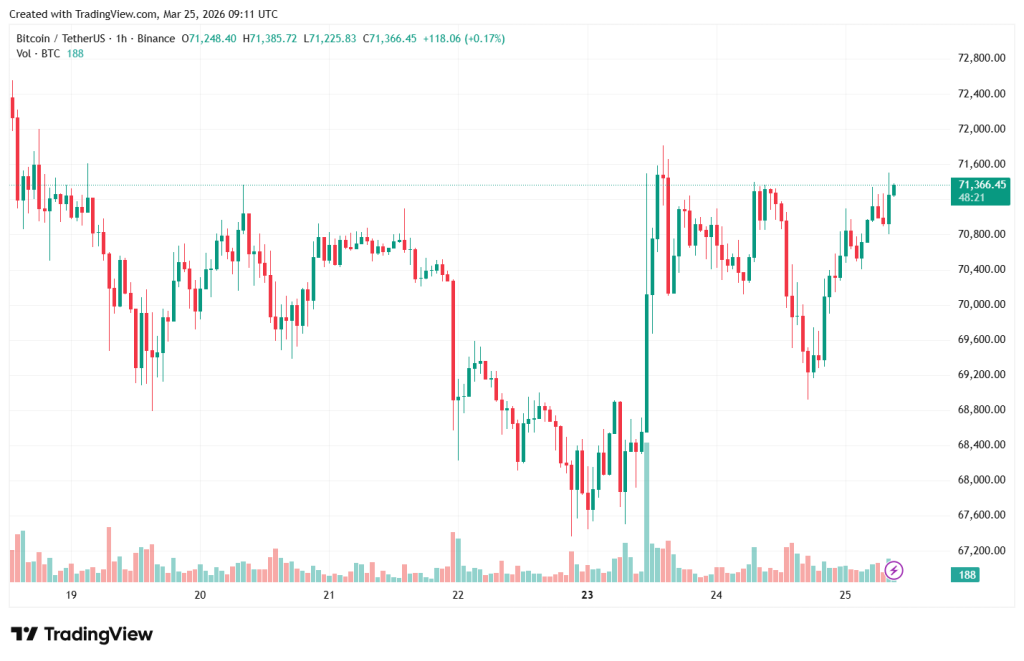
On a weekly basis, Bitcoin still shows a decline of 3.5%. However, digital gold has held above $70,000 for three consecutive days.
Senior analyst at FxPro, Alex Kuptsikevich, commented to CoinDesk on the stabilization of sentiment:
“Although the leading cryptocurrency has not transitioned to sharp growth, the ability to maintain current high levels speaks to the confidence of the bulls.”
Brent crude oil fell by 5.24% to $94.98, dropping below the $100 mark for the first time since mid-March.
On March 24, the analyst known as Sykodelic outlined a condition for Bitcoin’s price to rise to $200,000.