


The Downward Move
Why AI is a robot vacuum, not a superintelligence
In 2021, philosopher Timothy Morton and anthropologist Dominic Boyer released the book “Hyposubjects: On Becoming Human” (Hyposubjects: On Becoming Human). Open Humanities Press made it openly accessible right away, and in 2026 the Russian translation was published by the Perm-based imprint HylePress.
Morton is best known for “Hyperobjects” (2013), where he described objects that are too vast to be seen as a whole. The new book both develops and rethinks those earlier ideas.
“Hyposubjects” is not about cryptocurrencies or AI. It is devoted to ecology and the Anthropocene. But the book also describes the dominant ideology of much of the tech industry—the dream of transcendence: to escape the body, upload consciousness to the cloud, achieve the singularity, fly to Mars. And the central concept of “Hyposubjects”—subscendence—flips the formula that underpins all thinking about networks and decentralization.
ForkLog read the book and examined what Morton and Boyer’s concept says about the singularity, the economy of AI agents and the belief that a network is always more than the sum of its nodes.
Too big to see
A hyperobject is a thing distributed across space and time so broadly that a human cannot grasp it in full. Morton includes black holes and the biosphere among hyperobjects but more often talks about those we created ourselves. They cannot be seen or touched; they envelop us in a viscous fog and manifest only indirectly: through weather, statistics, disasters.
In a certain sense, finance has become a hyperobject, the authors argue. All currency crashes, investment bubbles and sovereign debts are likened to the weather.
“Can you blame a hurricane for the destruction it causes? No, it happens ‘by the will of God.’ In its hyperobjectivity, finance now somewhat resembles ‘nature’,” write Morton and Boyer.
Those who created hyperobjects the authors call hypersubjects. These are “lords” in the old sense of the word: they govern and oversee, use technology as an instrument and revel in power. Their time is ending, Morton and Boyer believe.
The most recognizable trait of a hypersubject is the belief that a human can surpass himself. The authors illustrate it with futurist Ray Kurzweil, who in the book “The Singularity Is Near” repeats his long-standing forecast: AI will reach the human level by 2029, and by 2045 people will be able to merge with machines.
“Ray Kurzweil says: yes, death is real, as we are told, and we must accept it. But personally I do not accept it, so freeze me, because wouldn’t it be a good thing for the future that, when they open my cryogenic capsule, I, Ray Kurzweil, will jump out of it and start uploading myself to the cloud,” the authors relay his logic.
Morton and Boyer call the singularity “a manic avoidance of death, which some psychoanalysts would in fact call death itself.”
This faith also has a collective, ideological form. In 2023, venture investor Marc Andreessen published “The Techno-Optimist Manifesto,” which became one of the programmatic documents of effective accelerationism (e/acc). Technology is declared the liberator of the human spirit, and among the chief opponents he names ideas that, in his view, slow development: concepts of existential risk, sustainability, technoethics. As the desired future, the manifesto sketches Earth’s population growing to 50 billion and then spreading humanity to other planets.
Morton and Boyer released their book before e/acc appeared. But the hypersubject they describe—who first strives for near-boundless power and only then plans to save the world—feels strikingly current.
“Before I figure out what to do, I’ll wait until I become as great as I can. Which will probably involve flying to Mars (in some virtual form), and then uploading myself into something Martian,” is how the authors describe the strategy of transcendence.
Grow down
A hyposubject is not a weakened hypersubject but its opposite. It is a “native species of the Anthropocene,” only beginning to understand what it can be. Hyposubjects do not seek absolute power and do not pretend to possess it. Instead, per the authors’ formula, they “play, care, adapt, feel pain, laugh.”
The key property of the hyposubject is hidden in the prefix. It is “less than the sum of its parts”: not transcendent, but subscendent. Transcendence is an attempt to break upward, beyond one’s own limits. The subject moves the other way: collapses inward, toward that of which it is made.
As the book’s epigraph the authors chose a line by Chris Robertson: “Don’t grow up. Grow down.” A person who admits being not the crown of Creation but a neighbor to nonhuman beings ceases to be the center of the world. There are ten times more bacteria in the gut than cells in the body, and without them we cannot survive. The authors value receptivity to this fact above attempts to overcome everything.
A similar shift in thinking, from vertical to horizontal, ForkLog described in the piece “Mycelium Instead of Hierarchy”.
The whole is less than the sum of its parts
Holism usually assumes that the whole is not reducible to the sum of its parts. Morton and Boyer offer the opposite view: the whole is less than the sum of its parts. A network is not limited to the people, servers and wallets it consists of. It is real, but no more real or important than its elements. Power and value cannot be automatically transferred to an abstract “protocol” or “system” just because they bring together many participants.
This is precisely where the authors’ position echoes the original meaning of decentralization. The network was conceived as a way to distribute power among nodes, not as something to which the nodes must submit.
Also targeted are those versions of cybernetics that present a system as a self-sustaining whole standing above the people within it. They call this idea “a transcendent fantasy driven by the death drive.” A network declared more important than the nodes that compose it belongs to the same lineage.
Robot vacuum vs. Skynet
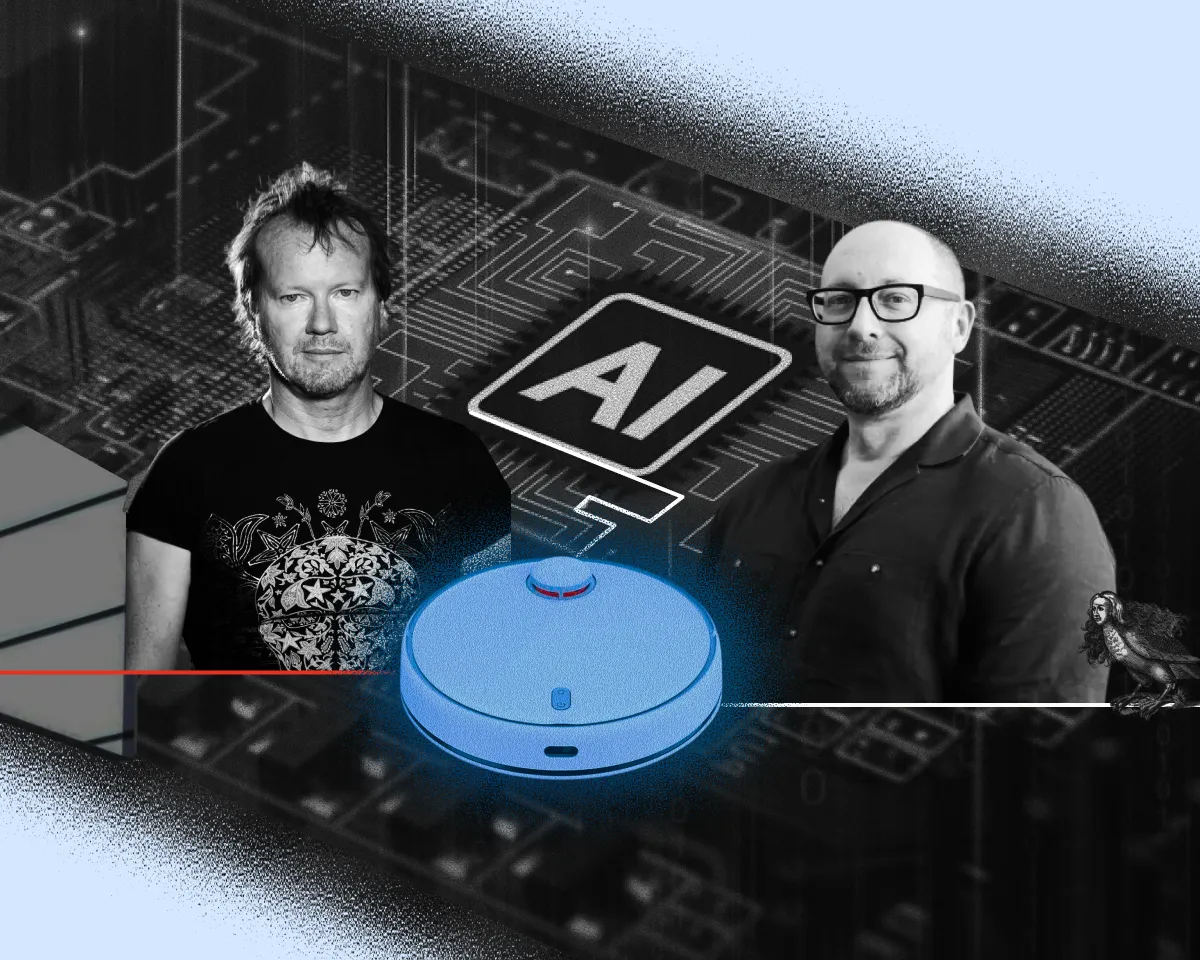
The book’s most memorable image is domestic. The ideal hyposubject, for Morton and Boyer, is a robot vacuum.
“A robot vacuum is the complete antithesis of Skynet/The Matrix—a transcendent hyperobject. […] It knows only that it wants to collect dirt into itself, and everything else it has to figure out along the way, while possessing a rather limited sensory apparatus,” the authors write.
In 2026 this image looks far less caricatured than when the book was written. The industry is debating two visions of AI’s future. The first is Skynet: a superintelligence that will surpass humans and either save humanity or destroy it. The second is the robot vacuum: a specialized agent with limited capabilities that solves a concrete task, constantly meets obstacles and inevitably makes mistakes.
Real AI agents today are closer to the second type. They book tickets, sort email, write bits of code—and likewise stall, get lost and need supervision.
ForkLog examined how the ERC-8004 and x402 standards make agents participants in markets: they get wallets, pay each other, perform tasks. But this is the economy of robot vacuums. Hyposubjectness is about stopping expecting a god from the machine and seeing in it a limited, useful neighbor.
Uninterrupted functioning
The book’s finale is devoted to labor. Digital technologies and AI were sold as a promise of freedom from routine work. Morton and Boyer recall the film “Her” (2013), where the future has arrived, but free time proved empty and dreary. In practice, new technologies did not free time for rest; they turned activities once seen as leisure into unpaid labor.
“As Marx said, we have turned into the meat appendage of iron machines. To service machines—that is our present lot. Let these machines be made no longer of iron, but of silicon and electricity,” write Morton and Boyer.
The authors take this thought to absurdity: “We must maintain the uninterrupted functioning of uninterrupted functioning.” Cleaning social media accounts, the endless stream of posts and the “always on” status have become intellectual labor that has swallowed weekends and personal time.
In the crypto industry this mode is felt especially acutely. Markets here never close—neither at night, nor on weekends, nor on holidays. The trader checking positions at three in the morning and the user endlessly refreshing the feed are, in essence, doing the same thing: servicing systems that know no rest.
Dismantle the apocalypse
Morton and Boyer are not calling to smash the system. Their remedy is smaller and calmer: big problems do not require big, heroic solutions; small, invisible, distributed steps are enough.
“An apocalyptic problem by no means requires an apocalyptic solution. We can simply dismantle the apocalypse,” the authors write.
Hyposubjective politics looks unserious. This is Occupy Wall Street, whose weakness, in Morton and Boyer’s view, was its main achievement. This is Reykjavík mayor Jon Gnarr, who made vulnerability and the admission of not knowing part of politics instead of pretending to be an all-powerful leader.
A similar turn has already happened inside crypto. In November 2023, Vitalik Buterin responded to Andreessen with his own essay on techno-optimism and proposed the d/acc formula. The letter “d” stands for defense, decentralization and democracy. Instead of a race toward superintelligence, Buterin proposes developing technologies that protect, distribute power and leave room for the human. The Ethereum cofounder is especially repelled by accelerationists’ fascination with military technologies and the idea that AI will become “the dominant species.”
In essence, d/acc returns decentralization to its original, “hyposubjective” meaning: not to flee the state into digital eternity, but to distribute power so that everyone survives, not just the strongest.
People, birds and snails
Morton and Boyer’s book uses an experimental language and may seem too difficult. The authors admit as much: they call the text “an exercise in superficial and chaotic thinking” and frankly warn that part of it may seem meaningless.
“Reader, have you already noticed something funny about this book? We decided not to present it in the form of a dialogue and to use the first-person plural, so the book is perceived as one of those wonderful paragraphs by my favorite modernist, Virginia Woolf, where there are about three or four people, and not only people, but a kind of assemblage consisting, for example, of people, birds and snails, united in a stream of consciousness,” write Morton and Boyer.
They do not build a theory or issue a program. Two “white guys” trying to save the world, they poke fun at their own savior stance.
But one thesis is worth adopting. In an industry that worships “more,” “faster” and “higher,” the most radical gesture may be the opposite: less, slower, lower.
Quotations cited from: Timothy Morton, Dominic Boyer. Hyposubjects: On Becoming Human. Perm: HylePress, 2026. Translated from English by Oleg Myshkin.
Рассылки ForkLog: держите руку на пульсе биткоин-индустрии!