


$2.15 Instead of 2–3% of Turnover: How goodPayments Crypto Processing Works
goodPayments is a non-custodial crypto payment processor for accepting USDT and TRX on the TRON network. The service forwards funds directly to the merchant’s wallet and charges a flat fee of 6.5/13 TRX ($2.15/$4.30) with no percentage of turnover.
Here’s how the product works — and at what turnover the flat-rate model pays off.
Benefits of Crypto Processing
According to Chainalysis, the adjusted on-chain settlement volume in stablecoins reached $28 trillion in 2025. By 2035, the figure could grow to $1.5 quadrillion — exceeding the entire current cross-border payments market.
A large share of that volume flows through TRON, which as of April 2026 holds 45% of the total USDT supply. According to CoinDesk Data, the network processed $2 trillion in USDT transfers during Q1 alone.
At the same time, businesses face high traditional acquiring costs. Stripe charges 2.9% + $0.30 per online transaction; PayPal — 3.49% + $0.49.
For industries that banks classify as high-risk, rates reach 6.5% + $0.20–0.35. On top of that, providers withhold a 5–15% rolling reserve: these funds remain frozen for 3–6 months. Until that period expires, the merchant cannot access the withheld money.
Crypto payment services typically cost less: fees run 0.5–1% or a flat amount unrelated to the payment size.
Chargebacks are another cost burden. A customer disputes a purchase through their bank, and the funds are debited from the merchant along with a provider penalty. According to a Mastercard report, 261 million chargebacks totaling $33.79 billion were filed in 2025. By 2028, the volume could reach 324 million at $41.69 billion.
About 45% of chargebacks are fraud-related: either someone used a stolen card or the buyer deliberately disputed a legitimate payment. On-chain payments eliminate this entirely — a finalized blockchain transaction is irreversible.
“Crypto processing has long moved past the experimental stage and become a fully functional business tool. This is especially visible in segments where traditional acquiring is either too expensive or risks asset freezes at any moment,” goodPayments representatives comment.
Processing Architecture
goodPayments operates exclusively on TRON with USDT (TRC-20) and the native TRX token. The team currently focuses on this blockchain because it remains one of the most popular networks in the CIS and Eastern Europe for transferring the largest stablecoin by market cap. The developers plan to add four more networks and expand the list of supported tokens in 2026.
A merchant creates an invoice through the dashboard or API: specifying the amount, accepted currencies, expiration time, and payment description. Optionally, they can add a callback URL for payment status notifications and a redirect page for after the payment.
The service generates a payment window with a QR code and a unique address. Two address types are supported:
- temporary — single-use, active only for the invoice duration (30 minutes by default). Monitoring stops after payment or expiration;
- static — a permanent address that accepts an unlimited number of incoming payments.
Once funds arrive, the next step kicks in. If the merchant has AML checks enabled, the transaction is validated against the configured risk threshold. If it passes, the service automatically forwards the funds to the merchant’s primary wallet, set in the dashboard. According to the team, the path from deposit to the merchant’s wallet takes 10–15 seconds.
“For each invoice, the system generates a unique wallet and monitors it for incoming funds. After payment, the transaction goes through an AML check — this is optional, the merchant can toggle it on or off. Then the funds move to the primary wallet configured in the dashboard,” goodPayments explains.
The private keys to the primary wallet belong to the merchant. The service has no access to them and technically cannot delay withdrawals, impose internal freezes, or close the account. This sets goodPayments apart from custodial processors, where funds first land in the provider’s shared hot wallet, and the merchant sees them as an entry in an internal ledger.
Dashboard
Registration on goodPayments is not automatic: after filling out the form, the application goes to an admin for manual approval, and only after confirmation does the merchant receive a password by email. The team says the process takes up to three hours. This approach filters out bots and mass signups.
The interface is built around four sections: Dashboard, Balance, Invoices, and Mass Payouts. Working wallet balances appear in the sidebar and remain visible on every screen. The dashboard displays active payment addresses and a summary of transactions and balance usage over the past 24 hours.
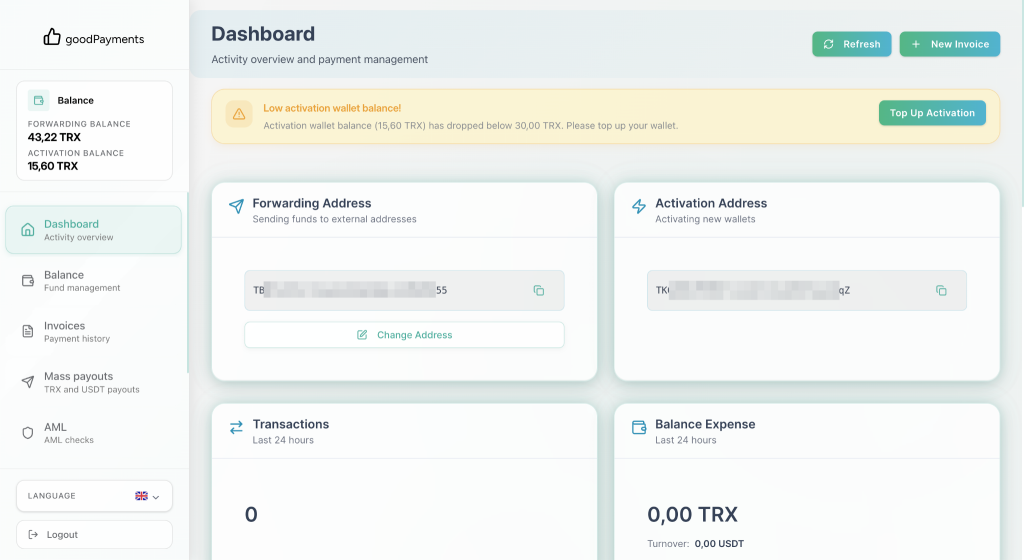
A key structural feature is the two separate working wallets in TRX:
- Forwarding — the primary balance that covers the service fee (6.5 or 13 TRX) for forwarding funds from the deposit address to the merchant’s wallet. Funds are not stored here — the balance is spent on fee payments;
- Activations — a separate balance for activating temporary addresses generated for invoices. A new TRON address is inactive by default — it cannot send outgoing transactions. If the payer sends TRX, the network activates the address automatically at no extra cost. With USDT this doesn’t happen, so the system sends a technical transaction (0.000001 TRX) from the merchant’s activation balance, costing 1.1 TRX (TRON network fee).
The Invoices section offers filters across eight parameters: invoice ID, receiving address, transaction hash, comment tag, date range, cryptocurrency, network, payment status, and address type — temporary or static. The table supports sorting by time, amount, status, and full-text search. This matters for bookkeeping reconciliation and for exchange services that need to quickly locate a specific transaction by hash or tag.
The transaction history for both wallets is available in the Balance section with filters by period, operation type, and account.
Flat Fee
The service’s main advantage is the absence of a turnover percentage. goodPayments charges a fixed amount per processed payment:
- 6.5 TRX — if payment arrives in TRX; or if the invoice is in USDT and the merchant’s primary wallet (where all deposits go) already holds USDT;
- 13 TRX — if payment is in USDT and the merchant’s primary wallet has no stablecoins. After the first USDT deposit, all subsequent transactions are processed for 6.5 TRX.
At a TRX price of roughly $0.33 as of April 2026, that’s $2.15 or $4.30 per transaction. The figures match the cost of a USDT transfer on TRON — goodPayments adds no markup to its rate.
The fee is not deducted from the payment amount — it’s charged to the merchant’s balance. If the “Include fees in invoice amount” flag is enabled, the fee is added on top and passed to the payer. When the balance hits zero, invoice processing pauses until it’s topped up.
The flat-rate model’s economics improve as the average ticket grows. The table below compares goodPayments with traditional acquiring (Stripe) and a typical crypto processor charging 1% plus a $2.15 network fee for forwarding:
| Ticket | goodPayments ($2.15) | Stripe (2.9% + $0.30) | Crypto processor (1% + $2.15 network fee) |
| $10 | $2.15 (21.5%) | $0.59 (5.9%) | $2.25 (22.5%) |
| $50 | $2.15 (4.3%) | $1.75 (3.5%) | $2.65 (5.3%) |
| $100 | $2.15 (2.2%) | $3.20 (3.2%) | $3.15 (3.2%) |
| $200 | $2.15 (1.1%) | $6.10 (3.1%) | $4.15 (2.1%) |
| $500 | $2.15 (0.4%) | $14.80 (3.0%) | $7.15 (1.4%) |
| $1,000 | $2.15 (0.2%) | $29.30 (2.9%) | $12.15 (1.2%) |
| $10,000 | $2.15 (0.02%) | $290.30 (2.9%) | $102.15 (1.0%) |
The break-even point with traditional acquiring is a $64 ticket: from that amount onward, goodPayments is cheaper than Stripe (2.9% + $0.30).
Against a crypto processor charging 1% + network fee, goodPayments wins at any ticket size. Both services pay the same $2.15 TRON network fee for forwarding, but the percentage-based processor adds 1% on top — goodPayments does not.
For merchants averaging $100+ per transaction, the savings add up. The baseline case cited by the goodPayments team is $100,000/month in turnover with 1,000 transactions at $100:
“A client had been using a crypto processor charging 1% of turnover plus network fees. They processed $100,000 per month, with payments averaging $100. Total: 6.5 x 1,000 = 6,500 TRX, roughly $2,080 in network fees, plus $1,000 in turnover commission. On goodPayments they pay only $2,080 — saving more than 30%.”
For the high-risk segment, the gap widens dramatically. At $500,000/month in turnover with 3,333 transactions at $150, a processor charging 6% would cost $30,000 plus a 5–15% rolling reserve. The same volume through goodPayments — $7,165. The difference: roughly $22,800 per month, not counting the frozen reserve.
AML Checks: Configurable Risk Threshold
The AML module in goodPayments is optional. When activated, every incoming transaction is validated against a risk threshold set by the merchant (0–100%). If the risk score exceeds the threshold, the funds are returned to the sender; if below — the transaction proceeds to the merchant’s wallet.
Each check costs $1, deducted in TRX at the current exchange rate from the primary balance. The fee applies regardless of the result — both on pass and on rejection. The check history with transaction hashes, risk scores, and PDF reports is stored in the dashboard.
According to the team, the module’s primary clients are exchange services, where screening incoming funds has become routine:
“If a merchant skips AML and aggregates all deposits into one wallet, a tainted transaction will flag the entire address. We enable merchants to accept payments to temporary addresses, screen them, and only then forward to the primary wallet. If contamination exceeds the threshold, the transaction is automatically returned to the sender,” goodPayments explains.
POS Terminal for Offline Businesses
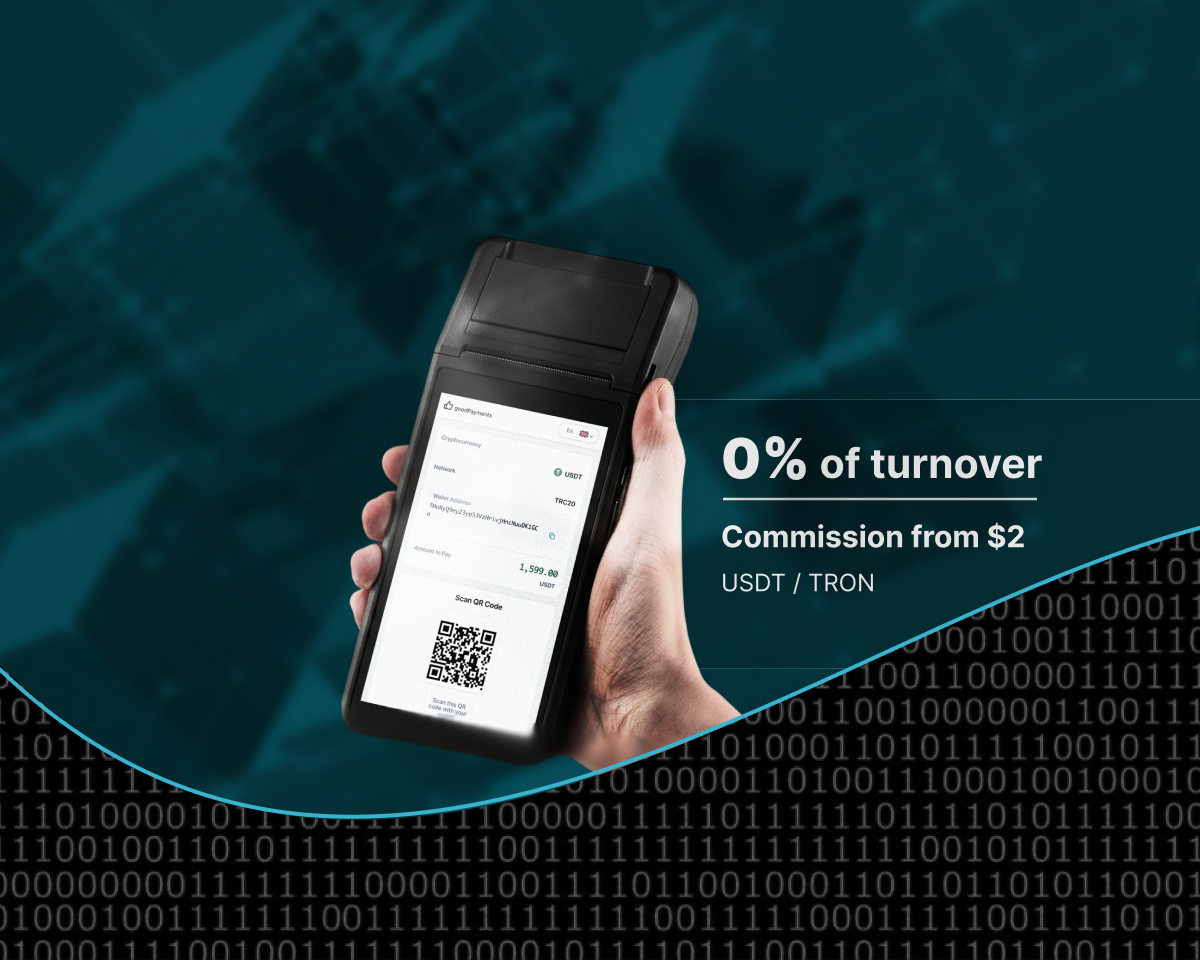
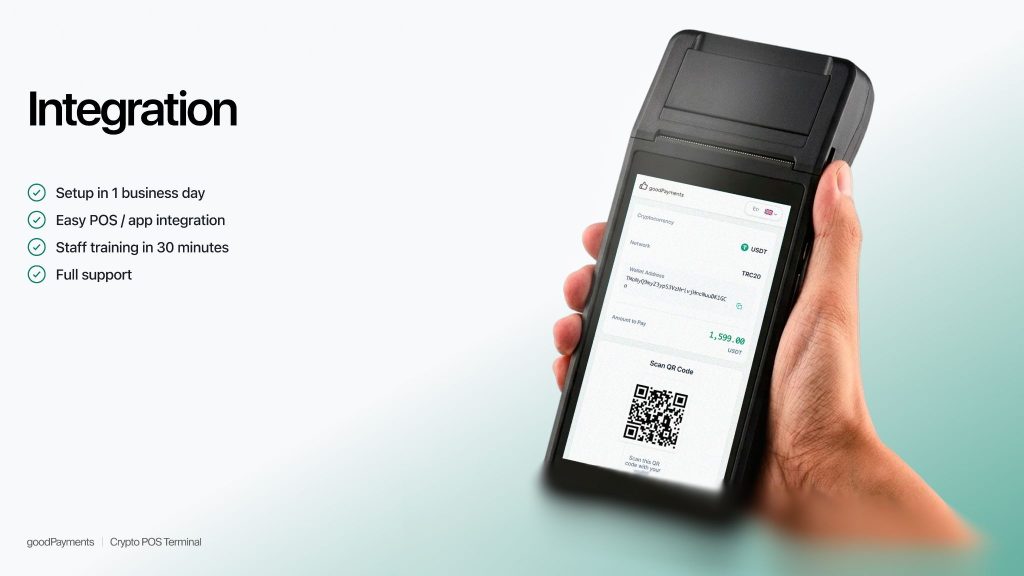
Beyond online processing, goodPayments is developing a POS solution for brick-and-mortar locations. According to the team, the cashier enters the amount, the POS generates a QR code, the customer pays from any compatible wallet, and confirmation arrives within 10–20 seconds.
The service offers auto-conversion from USDT to Russian rubles, US dollars, or euros with settlement to a bank account. Three modes are available: crypto-only, auto-conversion to fiat, or a combined option.
“Conversion is handled through an external partner — a licensed exchange service. The merchant signs an agreement with the partner and receives a deposit address. This address is passed to us, and we configure automatic forwarding of all deposits to the partner’s wallet, where conversion takes place. Settlement terms are set individually: some merchants choose daily payouts, others — weekly or monthly. The fee depends on the currency and country. For example, one of our clients converts funds to dirhams at a 2% fee,” goodPayments explains.
Setup takes one business day; staff training — about 30 minutes. Target industries include restaurants, hotels, retail, tourism, and healthcare.
Mass Payouts and Referral Program
In April 2026, goodPayments announced two updates expanding the dashboard functionality.
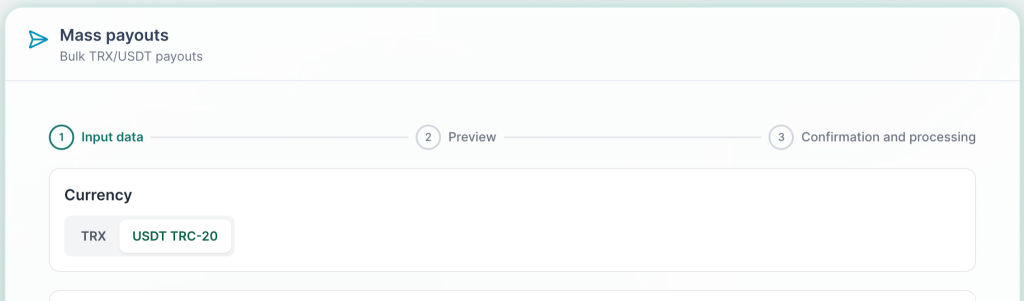
Mass payouts. The tool sends TRX or USDT (TRC-20) to hundreds of addresses in a single operation. Recipients can be added manually or uploaded as an XLSX, CSV, or TXT file (up to 5 MB). The process follows three steps:
- The merchant selects a currency and uploads a list of addresses with amounts.
- They see a summary: number of transactions, total payout amount, goodPayments fee in TRX, and the separate cost of activating new addresses (if the recipient has never held USDT).
- The service generates a temporary address. Once funds arrive, the payout starts automatically.
Progress displays in real time. If the temporary address holds insufficient funds, the service shows the shortfall. Payout history is stored in the Invoices section filtered by the “Mass Payouts” address type.
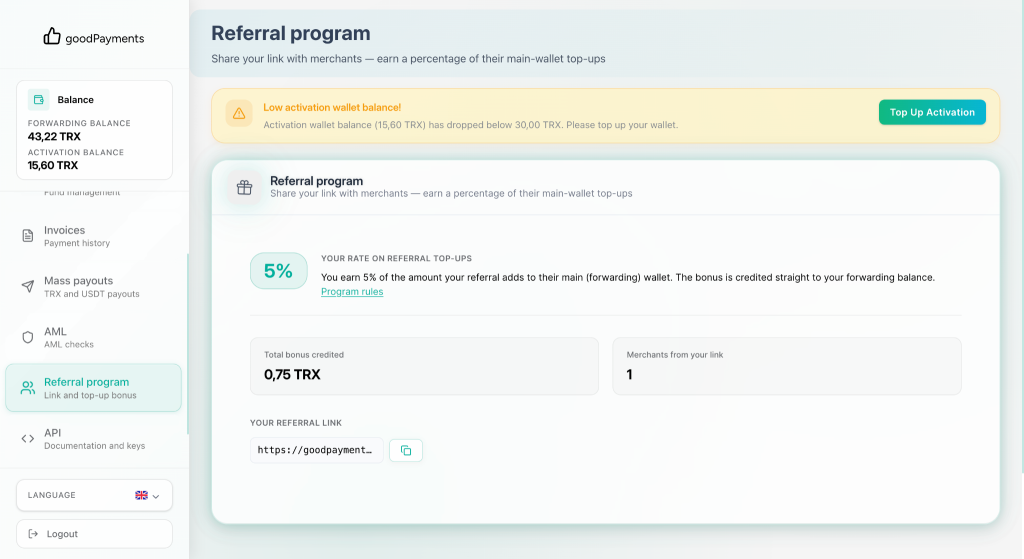
Referral program. Every merchant gets a personal referral link in their dashboard. A new merchant who signs up through it is automatically assigned to the referrer. The bonus is 5% on every top-up of the referred partner’s forwarding wallet balance.
The amount is instantly credited to the referrer’s forwarding balance — it can be used to pay fees, fund mass payouts, or be withdrawn. Top-ups of the activation wallet, invoice payments, and other operations are not counted. The referral page displays stats: the total TRX bonuses earned and the number of referred partners.
Who Is goodPayments For
goodPayments is a non-custodial processor for the TRON + USDT stack with a flat-fee model equal to the network fee. The service charges no percentage of turnover and does not hold user funds.
The product suits merchants with an average ticket of $65 or more. At $100–200, the savings versus Stripe and PayPal reach $1–4 per transaction; at $1,000+, savings hit tens of dollars. For micropayments, the flat fee loses to traditional acquiring — at small amounts, Stripe’s commission is lower. Against crypto processors with percentage-based fees, goodPayments is cheaper at any ticket size.
Strengths: direct forwarding to the merchant’s wallet in 10–15 seconds, configurable AML with automatic refund of tainted funds, mass payouts via XLSX/CSV, and a 5% referral program. Weaknesses: limited to the TRON network and reliance on an external partner for fiat off-ramps.
Product updates and new network announcements are available in the Telegram channel. For setup and POS inquiries, contact the manager.
FAQ
What is goodPayments?
goodPayments is a non-custodial crypto payment processor for accepting payments on the TRON network: USDT (TRC-20) and TRX. Funds go directly to the merchant’s wallet — the service does not hold them.
What fees does goodPayments charge?
The service fee for forwarding funds to the merchant’s wallet: 6.5 TRX if payment is in TRX or if the merchant’s primary wallet already holds USDT; 13 TRX if payment is in USDT and the merchant’s primary wallet has no USDT. At April 2026 rates, that’s $2.15 or $4.30 per transaction. Separately, 1.1 TRX is charged from the activation balance for activating a temporary address upon receiving USDT. AML checks are optional at $1 per address. No other fees apply.
What cryptocurrencies and networks does the service support?
As of April 2026, only USDT (TRC-20) and TRX on the TRON network. The team plans to add at least four new networks and expand the token list in 2026.
Is it safe to accept payments through goodPayments?
The service uses a non-custodial model: private keys are held by the merchant. The optional AML module returns tainted transactions to the sender before they reach the primary wallet. Risk threshold settings range from 0 to 100%.
Рассылки ForkLog: держите руку на пульсе биткоин-индустрии!